
Reflections from a Professional Development Workshop
As teaching artists, our most valuable professional learning experiences are those that strengthen both our artistic practice and our ability to guide meaningful learning. This November, I had the opportunity to participate in a two-part professional development workshop generously provided through the Ohio Teaching Artist Roster initiative and supported by OhioDance, the Ohio Alliance for Arts Education, the Ohio Arts Council, and Art Possible Ohio.
The workshop was facilitated by Jamin Carter, a visual artist, educator, and arts integration consultant whose work spans professional studio practice, classroom instruction, mentorship, and national arts integration training. Carter’s artistic work explores the relationship between memory, perception, and meaning, while his educational practice focuses on helping learners discover understanding through creative processes.
Although the workshop centered on visual arts, the concepts and strategies presented have direct applications across multiple art forms and subject disciplines. More importantly, the experience provided a powerful reminder that arts integration is not simply about making art. It is about helping learners construct and demonstrate understanding through artistic processes.
Lesson One: Using Symbols to Learn New Vocabulary
The first session explored several essential questions:
- What is a symbol?
- How can symbols help us learn new vocabulary?
- What tools can be used to create symbols?
Participants began by examining the idea that a symbol is something that represents something else. We discussed the difference between universal symbols, which carry broadly accepted meanings, and personal symbols, which derive meaning from individual experiences and interpretations.


Carter then demonstrated how symbols can become powerful learning tools. Rather than memorizing definitions, learners create visual representations that help encode meaning in their minds. Through this process, students actively construct understanding rather than simply receiving information.
The first workshop session focused on three simple design tools:
- Shape
- Color
- Size
Participants were introduced to unfamiliar vocabulary words, including attaccabottoni, benighted, and kiniology. Using only shapes, colors, and size, we created symbolic illustrations intended to communicate each word’s meaning.
What made the activity particularly effective was the realization that artistic skill was not the goal. Instead, the focus was on visual thinking, interpretation, and meaning-making. As participants shared their symbols, it became clear that different visual choices could communicate similar ideas while also revealing unique perspectives.
Using Padlet, participants uploaded their images for group review and discussion. The collaborative sharing process encouraged reflection and allowed us to examine how others interpreted the same vocabulary. Through discussion, we considered what worked, what we might change next time, and how symbolic representation supports deeper learning.
The session demonstrated that when students create symbols for new concepts, they become active participants in constructing knowledge rather than passive recipients of information.
Lesson Two: Facilitating Arts Learning
The second session shifted from creating symbols to understanding how arts learning can be facilitated within an educational setting.
Carter began by sharing the Kennedy Center’s definition of arts integration:
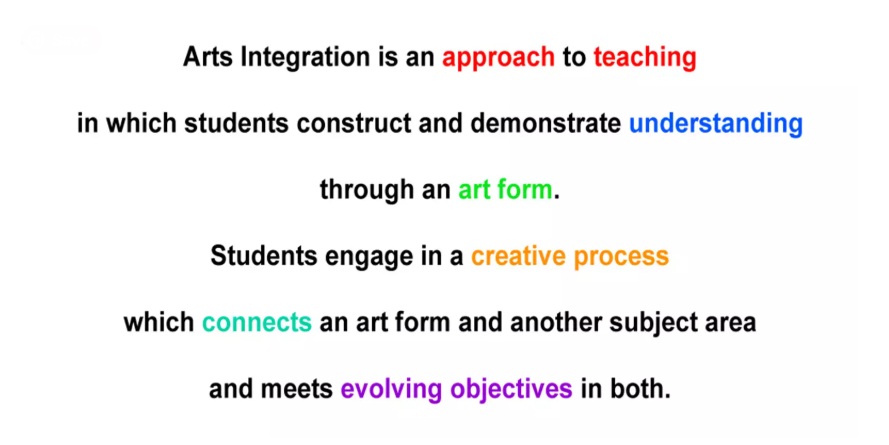
Arts Integration is an approach to teaching in which students construct and demonstrate understanding through an art form. Students engage in a creative process that connects an art form and another subject area and meets evolving objectives in both.
Silverstein, L. B., & Layne, S. (2020, January 14). What is arts integration? The John F. Kennedy Center for the Performing Arts. https://www.kennedy-center.org/education/resources-for-educators/classroom-resources/articles-and-how-tos/articles/collections/arts-integration-resources/what-is-arts-integration/
This definition served as the foundation for the lesson as participants explored a facilitation framework designed to guide students through creative inquiry and discovery.
The workshop followed a sequence that included:
- Exploring prior knowledge
- Making predictions
- Drawing symbols
- Retelling sequence
- Synthesizing learning through a gallery experience
- Acknowledging new arts learning
A particularly memorable portion of the session focused on a Creative Process Diagram. Carter connected this work to Michelangelo’s philosophy of sculpture, suggesting that the sculptor does not create the figure as much as reveal what already exists within the stone. This metaphor reinforced the role of the teaching artist as a facilitator who helps learners uncover and develop understanding.
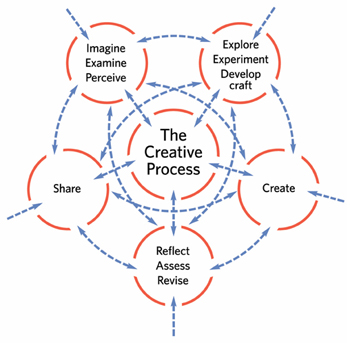
At the same time, the framework highlighted the responsibilities of the educator. Rather than A particularly memorable portion of the session focused on a Creative Process Diagram that visually separated the actions of the learner from the responsibilities of the facilitator. Carter connected this work to Michelangelo’s philosophy of sculpture, suggesting that the sculptor does not create the figure as much as reveal what already exists within the stone. This metaphor reinforced the role of the teaching artist as a facilitator who helps learners uncover and develop understanding rather than simply deliver information.
The diagram illustrated a creative learning journey that students move through as they construct understanding. Learners imagine, examine, perceive, explore, experiment, develop, craft, and create. They then reflect, assess, revise, and ultimately share their work and thinking. Rather than presenting learning as a straight path toward a predetermined answer, the framework acknowledged creativity as an ongoing process of discovery, reflection, and refinement.
Equally important was the distinction between what students do and what teachers do during the process. Blue arrows surrounding the diagram represented the educator’s role as a facilitator. Rather than directing every step, the teacher provides content and a creative problem to solve, guides opportunities for sharing and reflection, manages time, behavior, and materials, and assesses both understanding and skill development. Throughout every stage of the process, formative assessment is continuously present, allowing the educator to respond to student thinking while supporting growth and deeper understanding.
The framework demonstrated that effective arts-integrated instruction is not about controlling outcomes. Instead, it is about creating conditions that support exploration, encourage reflection, and help learners construct meaning through guided creative experiences. In this model, the teacher serves not as the source of all answers, but as the facilitator who helps reveal what students are capable of discovering.
To experience the process firsthand, participants worked with Jacqueline Woodson’s poem Sometimes No Words Are Needed. Before hearing the poem, we were given only the title and asked to create symbolic representations using the skills introduced in the first session: shape, color, and size.
Later, two additional visual elements were introduced:
- Space
- Line
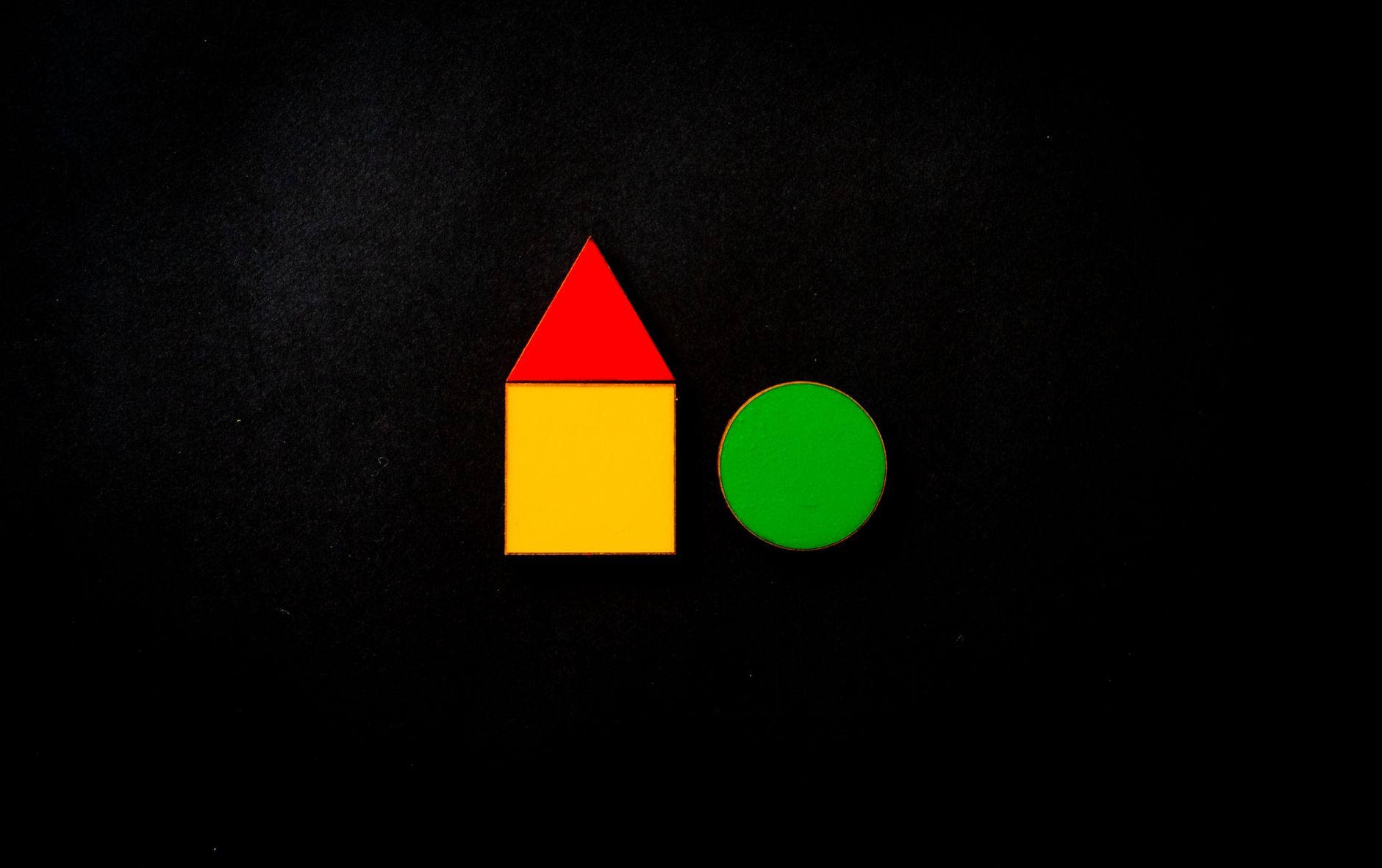




After listening to the poem, participants revisited their symbols and created new representations using all five visual elements. This allowed us to compare our initial predictions with our later understanding and observe how new information influences interpretation.
The lesson concluded with opportunities to share artwork, discuss thinking, summarize the learning sequence using “First, Next, Then, Finally,” and identify a single symbol that best captured the poem’s central idea.
Leadership Insight: Learning Through Facilitation
One of the most important lessons from this workshop was the distinction between teaching content and facilitating learning.
Effective arts integration is not about telling students what to think. It is about designing experiences that encourage curiosity, interpretation, exploration, and reflection. The educator provides structure, prompts, and opportunities for discovery while leaving room for learners to construct their own understanding.
This approach requires trust in the creative process. It recognizes that meaningful learning often emerges through experimentation, revision, discussion, and personal connection.
Forward Motion Skills in Action
The activities modeled throughout both sessions strengthened a variety of transferable skills that are essential for success both in and beyond the classroom:
- Creative problem-solving
- Observation
- Reflection
- Communication
- Self-expression
- Perspective-taking
- Flexibility of thought
- Critical thinking
These skills are central to the Forward Motion Framework and support learners as they develop confidence, agency, and the ability to make meaning from new experiences.
Academic Transfer
The strategies explored in this workshop also demonstrate clear academic applications. Symbolic representation and creative interpretation support:
- Vocabulary acquisition
- Reading comprehension
- Prediction and inference
- Sequencing
- Summarization
- Memory retention
- Visual literacy
- Critical analysis
By engaging students in creative processes, arts-integrated instruction provides additional pathways for understanding and communicating academic content.
Conclusion
Jamin Carter’s workshop provided far more than a collection of visual arts activities. It offered a thoughtful model for how teaching artists and educators can facilitate learning through inquiry, creative process, and reflection.
The experience reinforced a principle that applies across all arts disciplines: students learn most deeply when they are invited to construct meaning for themselves. Whether through drawing, movement, storytelling, music, or drama, artistic processes create opportunities for learners to connect prior knowledge, explore new ideas, and demonstrate understanding in authentic ways.
As teaching artists, our role is not simply to provide answers. Our role is to create the conditions where discovery can occur. When we facilitate learning in this way, we help students move beyond memorization and toward lasting understanding, creative confidence, and meaningful engagement with the world around them.

Leave a Reply