
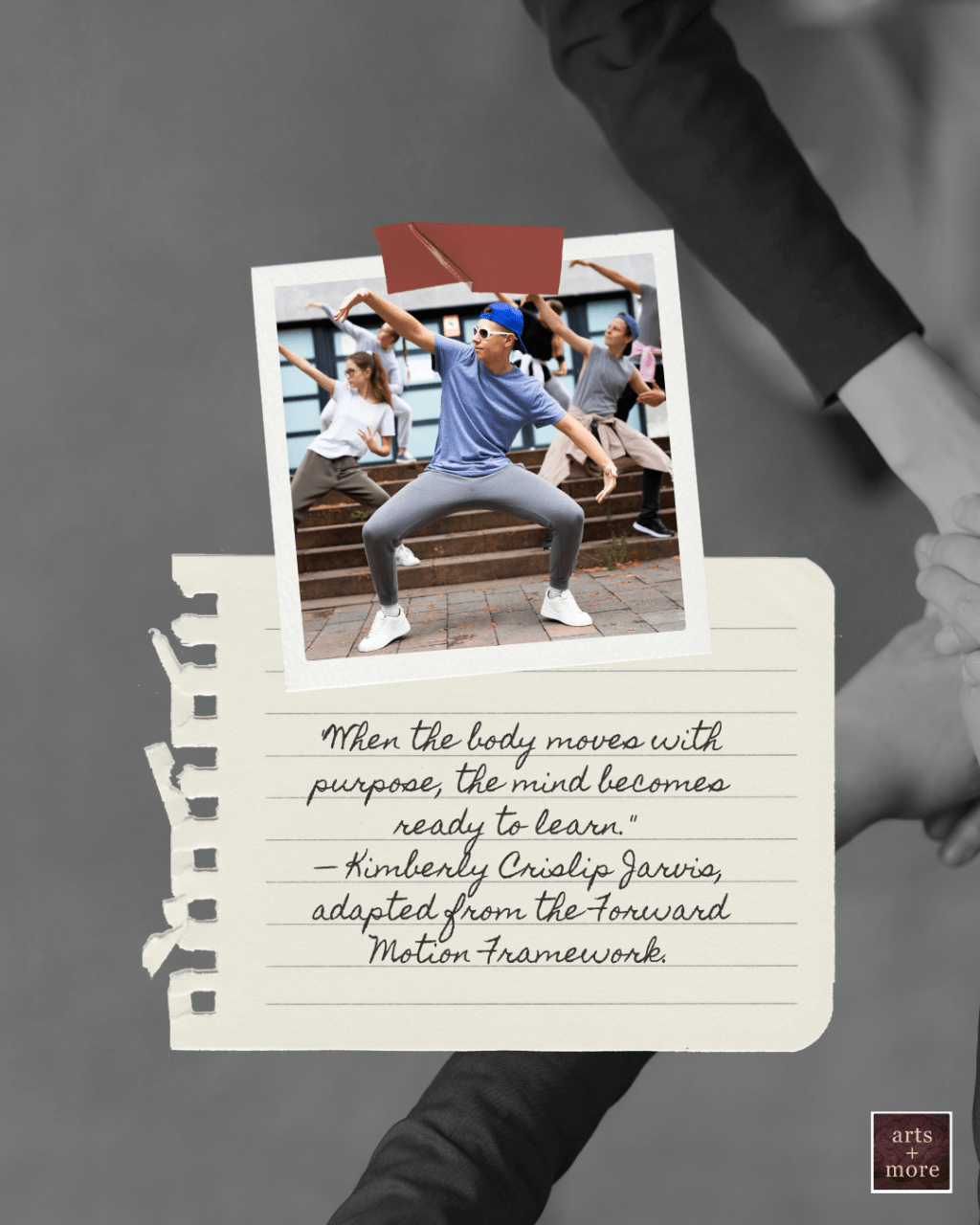
A few days ago, I came across a post by Instagram creator @the.therapist.who.moves.you that reinforced what we know intuitively. One sentence especially stayed with me:
“Dance is how humans metabolize life.”
As educators, teaching artists, and school leaders, we spend a great deal of time discussing academic achievement, student engagement, behavior, and wellness. Yet sometimes we forget that the body is the first classroom. Before students can fully engage their minds, they must be connected to themselves.
Movement Came First
Long before humans developed written language, we communicated through movement. We rocked infants, celebrated through dance, gathered in circles, and expressed emotions through our bodies.
Movement wasn’t entertainment.
It was survival.
It was communication.
It was regulation.
Today, students arrive carrying far more than backpacks. They bring stress, anxiety, excitement, disappointment, uncertainty, and energy into the classroom. When those experiences remain trapped in the body, they can become barriers to learning.
Movement provides a pathway.
A child who dances, stretches, balances, skips, sways, or creates movement patterns is doing far more than exercising. They are organizing their nervous system, activating sensory pathways, and preparing their brain for learning.
The Science Behind the Movement
When students engage in purposeful movement, the brain begins creating and strengthening neural connections. Researchers continue to find links between movement, attention, memory, emotional regulation, and executive functioning.
This is why movement arts integration is a learning strategy.
When students move concepts, embody stories, create physical representations of math and science ideas, or collaborate through creative movement, they engage multiple areas of the brain simultaneously. Learning becomes something they experience rather than something they passively receive.
Movement education is a form of neuromapping.
The body becomes a partner in cognition.
The result is greater readiness to learn, stronger retention, and increased engagement.
Forward Motion Skills in Action
Every movement experience develops transferable skills students need both inside and outside the classroom.
Self-Regulation
Movement helps students identify and manage their energy, emotions, and attention. Through breathing, rhythm, balance, and structured movement activities, students learn how to shift from dysregulation to focus.
Emotional Literacy
Dance gives students a safe way to express feelings that may be difficult to put into words. Joy, frustration, excitement, and uncertainty can all be explored through movement.
Collaboration
Group movement experiences require listening, cooperation, shared decision-making, and trust. Students learn how to contribute while remaining aware of others.
Spatial Awareness
Students develop an understanding of personal space, shared space, directionality, patterns, and relationships—all foundational skills for learning and social interaction.
Creative Problem-Solving
When students create movement solutions, interpret concepts physically, and generate original responses, they strengthen flexible thinking and innovation.
We would never expect students to solve complex math problems immediately after running a sprint without first helping them regulate and focus. Yet, we often expect students to arrive at school after the family sprint to arrive. Many children must learn while being disconnected from their bodies.
Movement arts integration reminds us that preparation matters.
The most effective classrooms are not simply places where information is delivered. They are environments where students are physically, emotionally, and mentally ready to receive it.
When leaders prioritize movement, they are not taking time away from learning.
They are creating the conditions that make learning possible.
Academic Transfer
Movement arts integration supports academic growth across all content areas.
- Movement activates multiple brain regions at once — motor cortex, cerebellum, parietal cortex, and hippocampus — creating stronger, more durable learning pathways
- Using the body to explore shapes, pathways, and spatial relationships engages the parietal cortex, strengthening geometric reasoning.
- Acting out scientific processes taps into procedural memory systems, helping students encode sequences and cause‑and‑effect more deeply.
- Embodying characters or story structures activates mirror neurons, emotional processing centers, and narrative networks, improving literacy comprehension.
- Role‑play in social studies engages episodic memory and perspective‑taking networks, making historical understanding more meaningful and memorable.
- Rhythm, patterning, and sequencing in movement activate cerebellar timing systems and pattern‑recognition circuits, reinforcing mathematical reasoning.
The learning becomes visible, memorable, and meaningful.
Moving Forward
Perhaps the question is not whether students need more movement.
Perhaps the question is whether we can afford to continue separating movement from learning.
Look, I’m not playin’. The body was designed to move. The brain was designed to learn through movement. And students deserve educational experiences that honor both.
This belief sits at the heart of the Forward Motion Framework.
When movement becomes intentional, students strengthen wellness, build transferable life skills, and deepen academic understanding simultaneously.
Dance is not extra.
Movement is not a reward.
It is preparation.
It is regulation.
It is learning.
And perhaps, as the original post suggested, it remains one of humanity’s oldest and most powerful ways of making sense of life.
#DanceIsMedicine#EveryBodyDanceNow#MovementHeals#DanceTherapy#TheTherapistWhoMovesYou
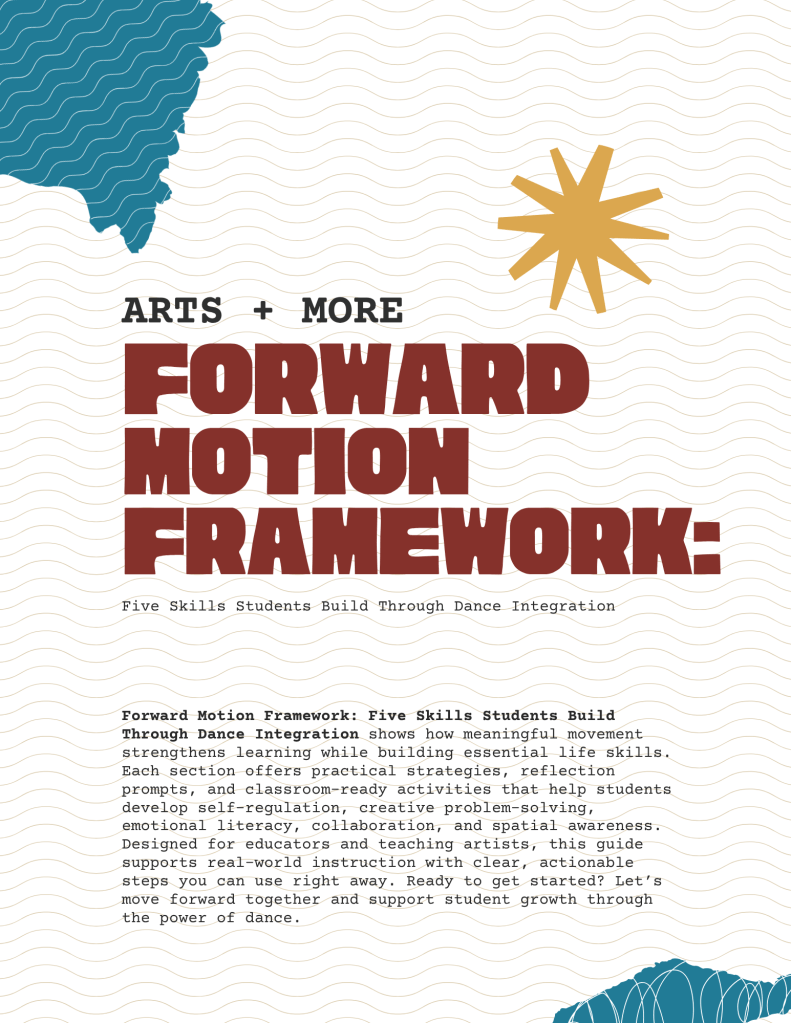
Ready to bring consistency, trust, and impact to your work?
I invite you to download the Forward Motion Framework for practical tips to clarify your goals, identify barriers, and create an action plan for forward movement…
…WHICH MEANS you’ll start showing up with intention for your students and your creative projects today.
If you’ve found value in this work, I would love to hear from you. A short testimonial, Google Review, or comment helps me improve and shows others the difference we’re striving to make together.


Leave a Reply