
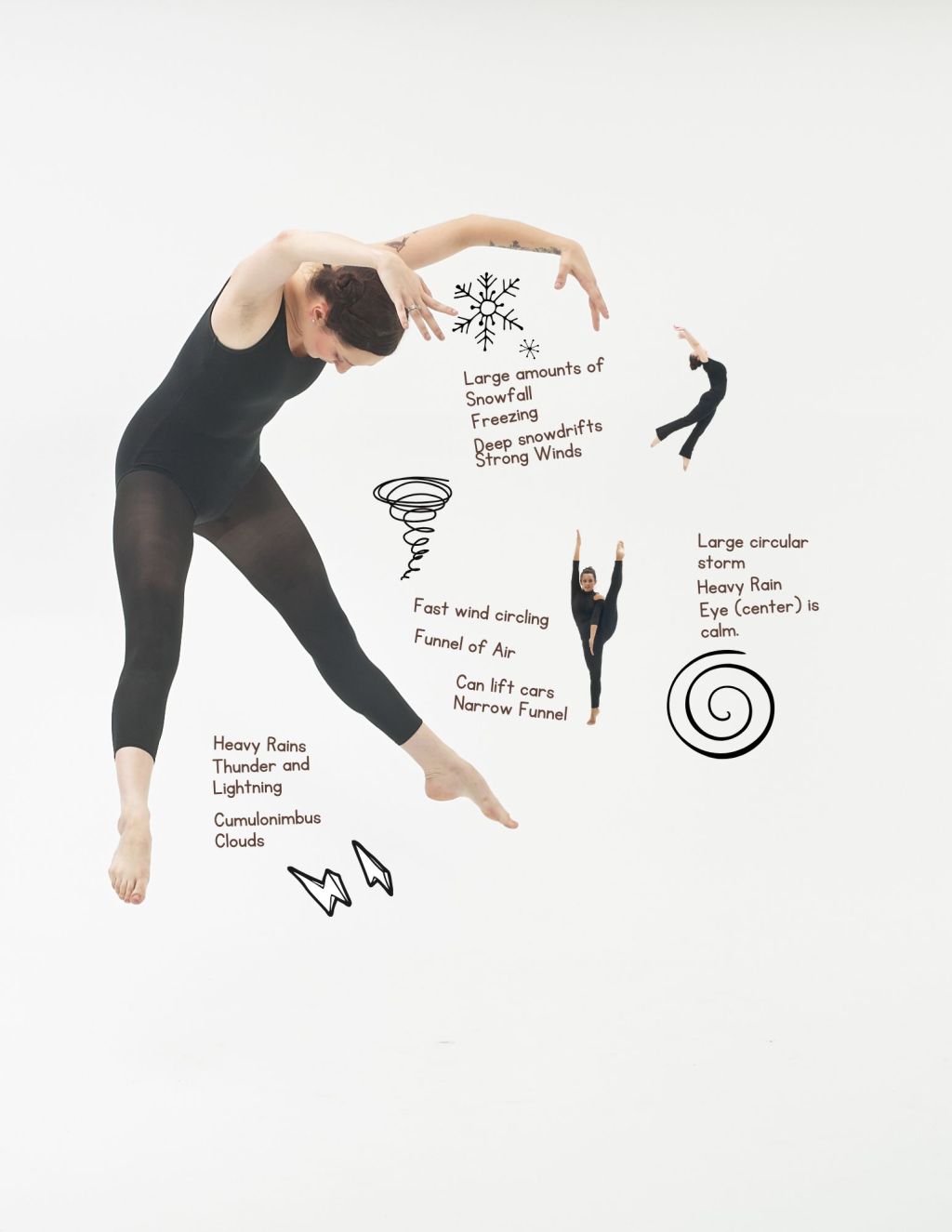
Storms are some of nature’s most powerful weather events. In this lesson, students explore how thunderstorms, blizzards, tornadoes, and hurricanes develop and behave. Through movement, students investigate the forces that create storms, the characteristics that make each storm unique, and the sequence of events that lead to a storm’s beginning, climax, and end. By combining scientific observation with creative movement, students experience weather systems in an active and memorable way while strengthening both science understanding and dance skills.
Grade Level
3rd–5th Grade
Duration
1–2 Class Periods (30–45 minutes each)
Standards
Science Standards
Earth and Space Science
- Air masses and fronts influence weather patterns.
- Storms develop under specific atmospheric conditions.
- Different storms have unique characteristics and impacts.
Dance Standards
Creating
- Create movement sequences that represent scientific concepts.
Performing
- Perform movement studies using a variety of movement qualities.
Responding
- Analyze how movement communicates ideas.
Connecting
- Use dance to demonstrate understanding of weather systems.
Essential Questions
- How do storms form?
- What makes different storms unique?
- How can movement communicate weather events?
Learning Objectives
Students will:
- Identify characteristics of thunderstorms, blizzards, tornadoes, and hurricanes.
- Use movement to represent storm development.
- Observe and analyze storm performances.
Success Criteria
Understanding Storms
- I can identify different storm types.
- I can describe what causes each storm.
Movement Exploration
- I can use speed, energy, weight, and levels to communicate a storm.
Vocabulary
Science Vocabulary
- Thunderstorm
- Blizzard
- Tornado
- Hurricane
- Front
- Air Mass
Dance Vocabulary
- Weight: Strong, Light
- Level: High, Middle, Low
- Speed: Slow, Medium, Fast
- Energy: Smooth, Sharp
Materials
Storm assignment cards
Open movement space
Observation worksheet
Lesson Activities
Activity One: How Storms Begin
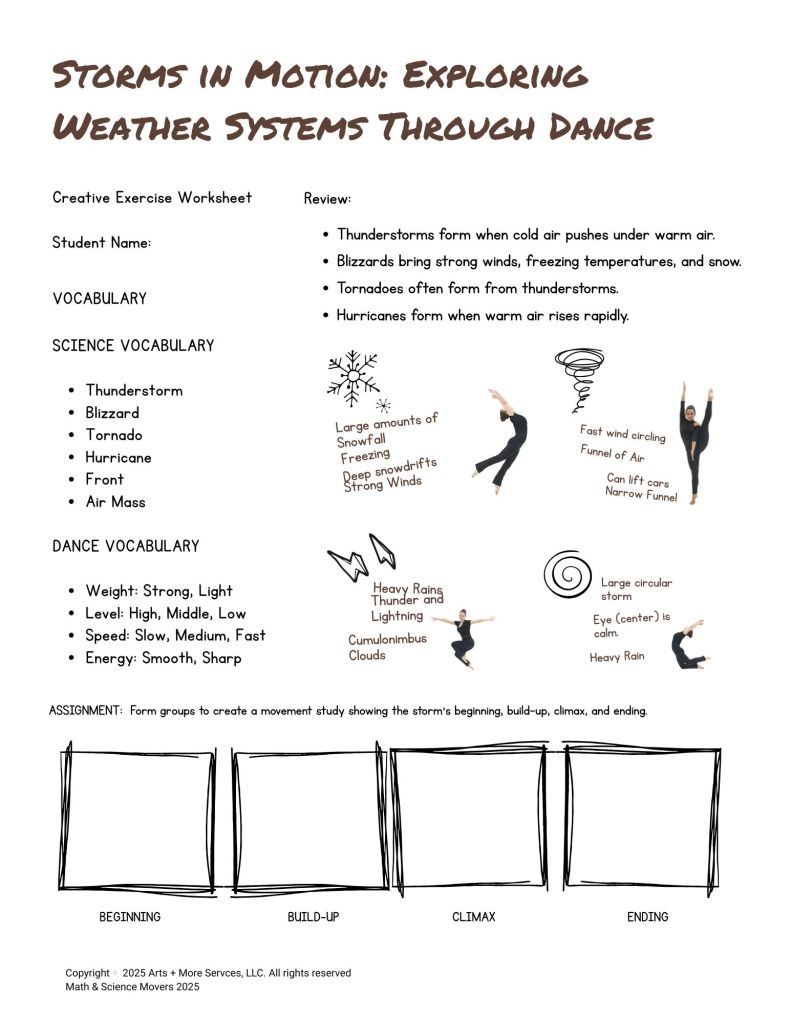
Review:
- Thunderstorms form when cold air pushes under warm air.
- Blizzards bring strong winds, freezing temperatures, and snow.
- Tornadoes often form from thunderstorms.
- Hurricanes form when warm air rises rapidly.
Discuss what causes each storm.
Activity Two: Storm Teams
Assign groups:
Blizzard
- Large snowfall
- Strong winds
- Freezing temperatures
Thunderstorm
- Heavy rain
- Thunder
- Lightning
- Cumulonimbus clouds
Tornado
- Funnel cloud
- Fast-rotating winds
- Narrow shape
Hurricane
- Large circular storm
- Heavy rain
- Calm eye
Groups create a movement study showing:
- Beginning
- Build-up
- Climax
- Ending
Activity Three: Storm Showcase
Groups perform.
Audience members answer:
- Which storm was shown?
- What movement made it clear?
- Could you tell what caused the storm?
- How was the climax shown?
- How did the storm end?
Adaptations and Modifications
Learner Needs Addressed
Students with varying physical, sensory, and learning needs.
Adapted Materials
- Storm picture cards
- Seated movement options
- Visual supports
Instructional Strategies
- Model movement vocabulary.
- Break storm creation into steps.
- Use visual examples.
Peer Support & Grouping Ideas
- Mixed-ability groups.
- Assigned roles within teams.
Assessment
Students identify storm types and explain how movement represents storm characteristics.
Lesson Conclusion
Storms are powerful weather events caused by interactions within Earth’s atmosphere. By creating and observing movement studies, students explored how storms begin, grow, and change, using dance to make weather concepts visible and memorable.
Ready to bring consistency, trust, and impact to your work?
I invite you to download the Forward Motion Framework for practical tips to clarify your goals, identify barriers, and create an action plan for forward movement…
…WHICH MEANS you’ll start showing up with intention for your students and your creative projects today.
If you’ve found value in this work, I would love to hear from you. A short testimonial, Google Review, or comment helps me improve and shows others the difference we’re striving to make together.


Leave a Reply