
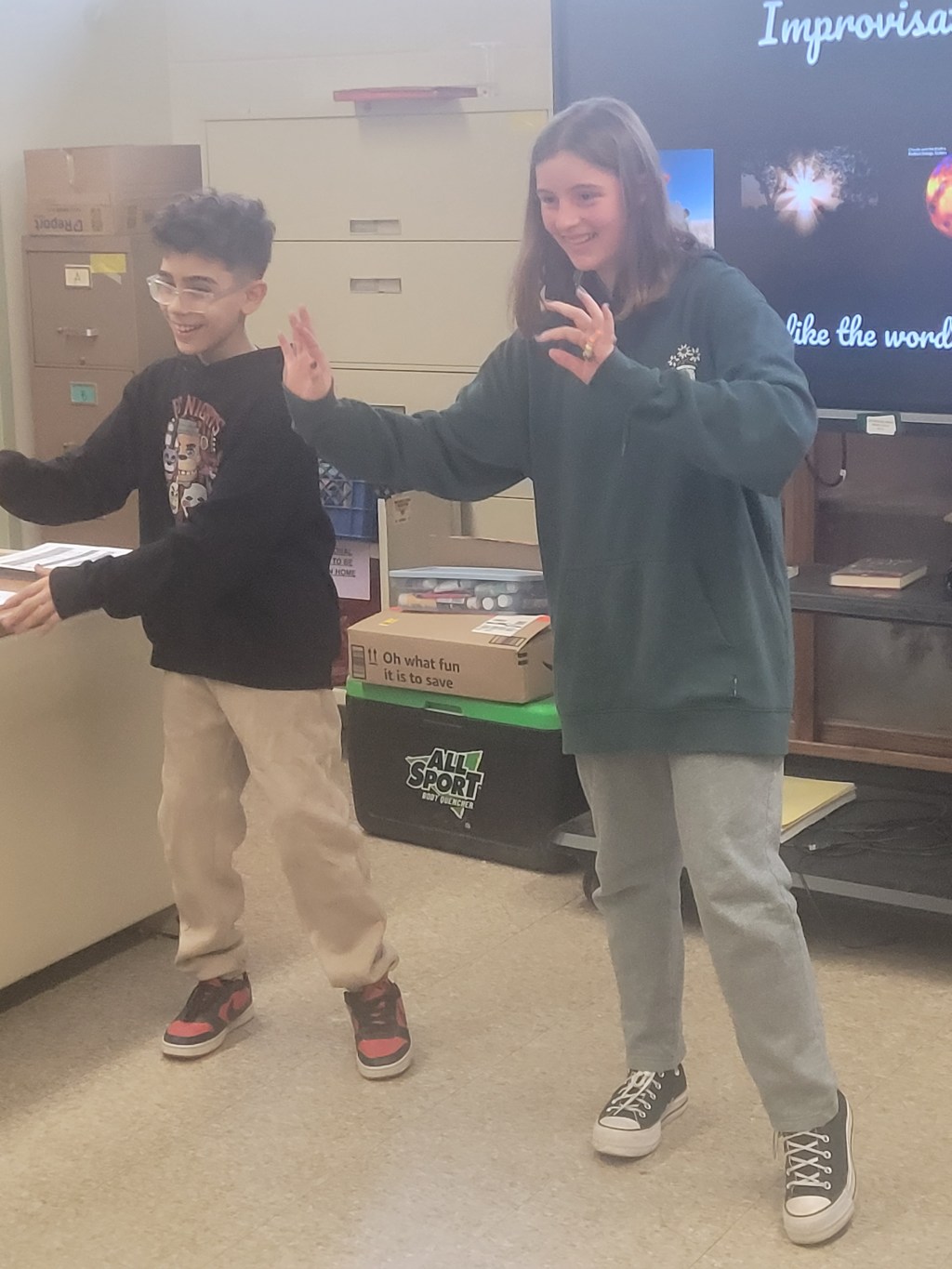
Everything in the universe is made of matter. A baseball bat, a bucket of water, and the air in a room are all made of tiny particles called atoms. These particles behave differently depending on whether matter is a solid, liquid, or gas. In this lesson, students explore how particles move in each state of matter and how physical changes occur. Through movement, students model particle behavior and experience scientific ideas in an active and memorable way while strengthening both science understanding and dance skills.
Grade Level
3rd to 5th Grade
Duration
1 to 2 Class Periods (30 to 45 minutes each)
Standards
Science Standards
Matter exists in different states and is made of tiny particles. Physical changes occur when matter changes state but remains the same substance.
Dance Standards
- Creating: Create movement sequences that represent scientific concepts.
- Performing: Perform movement studies using a variety of movement qualities.
- Responding: Analyze how movement communicates ideas.
- Connecting: Use dance to demonstrate understanding of physical science concepts.
Essential Questions
- What is matter made of?
- How do particles behave in solids, liquids, and gases?
- How can movement show the differences between states of matter?
Learning Objectives
Students will:
- Identify characteristics of solids, liquids, and gases.
- Use movement to represent particle behavior in each state of matter.
- Observe and analyze movement studies that show physical changes.
Success Criteria
Understanding Matter
- I can describe how particles move in solids, liquids, and gases.
- I can explain what happens during a physical change.
Movement Exploration
- I can use space, energy, and levels to show particle behavior.
Vocabulary
Science Vocabulary
- Matter
- Solid
- Liquid
- Gas
- Vapor
- Particles
- Atom
- Physical Change
Dance Vocabulary
- Space: Near, Far
- Energy: Bound, Free
- Level: High, Middle, Low
- Shape: Tight, Loose
Materials
- State of matter cards
- Open movement space
- Observation worksheet
Lesson Activities
Activity One: What Is Matter
Review: Matter is made of tiny particles called atoms. Particles are too small to see. Solids have tightly packed particles. Liquids have loosely connected particles that flow. Gases have particles that spread out and move freely.
Discuss how particle movement creates each state of matter.
Activity Two: Particle Movement Teams
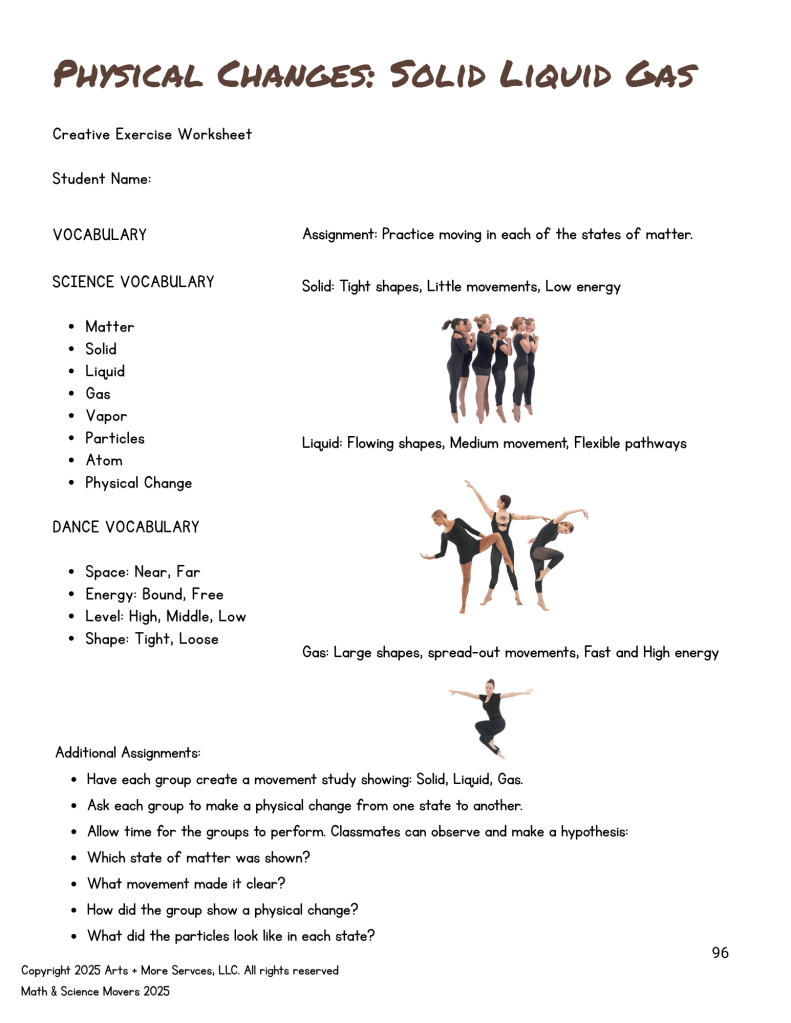
Assign groups:
- Solid: Tight shapes, Little movements, Low energy
- Liquid: Flowing shapes, Medium movement, Flexible pathways
- Gas: Large shapes, spread-out movements, Fast and High energy
Have each group create a movement study showing: Solid, Liquid, Gas.
Then, ask each group to make a physical change from one state to another.
Activity Three: Matter Showcase
Allow time for the groups to perform. Classmates can observe and make a hypothesis:
- Which state of matter was shown?
- What movement made it clear?
- How did the group show a physical change?
- What did the particles look like in each state?
Adaptations and Modifications
Learner Needs Addressed
Students with varying physical, sensory, and learning needs.
Adapted Materials
- State of matter picture cards
- Seated movement options
- Visual supports
Instructional Strategies
- Model particle movement.
- Break each state into clear steps.
- Use visual examples and sentence frames.
Peer Support and Grouping Ideas
- Mixed ability groups
- Assigned roles such as particle mover, shape leader, or narrator
Assessment
Students identify states of matter and explain how movement represents particle behavior and physical changes.
Lesson Conclusion
Matter is made of tiny particles that behave differently in solids, liquids, and gases. By creating and observing movement studies, students explored how particles move and how physical changes occur. Dance helped make these invisible scientific ideas visible and memorable.
Ready to bring consistency, trust, and impact to your work?
I invite you to download the Forward Motion Framework for practical tips to clarify your goals, identify barriers, and create an action plan for forward movement…
…WHICH MEANS you’ll start showing up with intention for your students and your creative projects today.
If you’ve found value in this work, I would love to hear from you. A short testimonial, Google Review, or comment helps me improve and shows others the difference we’re striving to make together.



Leave a comment