
This lesson connects basic life science with movement. Students explore how oxygen and carbon dioxide move between humans and plants, then embody the cycle through structured dance activities. The goal is a clear understanding paired with physical expression.
Grade Level Band
Grades 3–5
Duration
45 minutes
Science Standards
- Life Science: Interactions within ecosystems
Code: 5.LS.2
“All of the processes that take place within organisms require energy.” - Energy flow and matter cycling
Code: 4.LS.1
“Changes in an organism’s environment are sometimes beneficial and sometimes harmful.” - Plants and animals depend on one another for survival
Code: 5.LS.1
“Organisms perform a variety of roles in an ecosystem.”
Ohio Dance Standards (2012 Ohio Learning Standards for Dance)
- Creating: Generate and conceptualize movement ideas
Code: DA:Cr1.1.3–5 - Performing: Develop and refine artistic work
Code: DA:Pr4.1.3–5 - Responding: Interpret the meaning in movement
Code: DA:Re7.1.3–5 - Connecting: Relate dance to other disciplines
Code: DA:Cn10.1.3–5
Essential Questions
- How do plants and animals depend on each other?
- What happens to the air we breathe in and out?
- How can movement show a scientific process?
Learning Objectives
- Explain the oxygen–carbon dioxide cycle
- Identify the roles of plants and mammals
- Represent the cycle through movement patterns
Success Criteria (I Can Statements)
- I can describe how oxygen and carbon dioxide move
- I can show the cycle using my body
- I can explain why plants and animals need each other
Vocabulary (Science and Dance)
- Oxygen – A gas in the air that humans and animals breathe in to live.
- Carbon Dioxide – A gas that humans and animals breathe out; plants use it to grow.
- Atmosphere – The layer of air surrounding the Earth.
- Inhale – To breathe air into the lungs.
- Exhale – To breathe air out of the lungs.
- Cycle – A process that repeats over and over again.
- Plants – Living things that make their own food using sunlight, air, and water.
- Mammals – Animals that breathe air, have hair or fur, and feed their young with milk. Movement – The way the body travels or changes position.
- Pathway – The path or direction a body takes while moving.
- Flow – The smooth way movement connects from one action to another.
- Energy – The strength or force used to move the body.
- Pattern – A repeated sequence of movements.
- Sequence – A set of movements arranged in a specific order.
Materials
Chart paper, markers, blue scarf, green scarf, open space, music (optional), visual diagram of the cycle
Lesson Activities
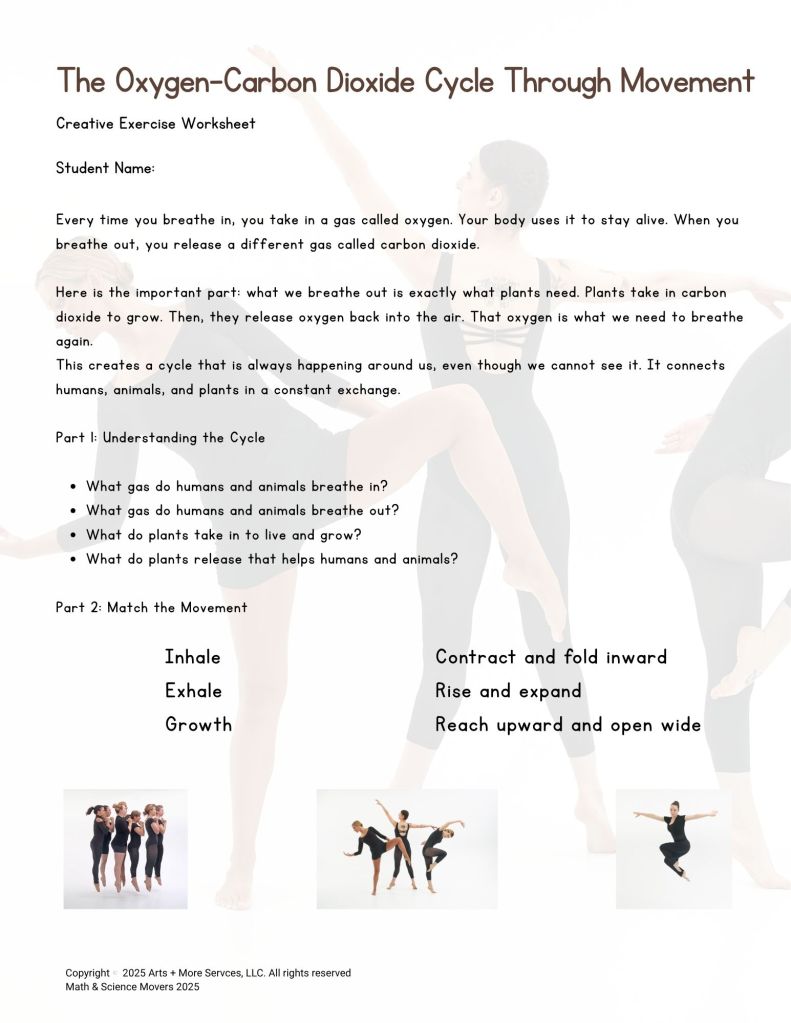
Activity One: Understanding the Cycle (15 min)
Students work in pairs to model the exchange of gases using movement and visual cues.
Set-Up
Provide each pair with:
- One blue card (oxygen)
- One green card (carbon dioxide)
Students stand facing each other. One begins holding the blue card.
Movement Sequence
- Inhale (Receive Oxygen)
The receiving student slowly rises, expanding arms and chest.
They take the blue card from their partner as they open their body. - Exhale (Release Carbon Dioxide)
The same student contracts inward, folding arms toward the body.
As they close, they hand off the green card to their partner. - Partner Response
The partner now repeats the same sequence:
Inhale to receive, exhale to release.
Cycle Flow
Students continue passing cards back and forth in a steady rhythm. Emphasize:
- Smooth transitions (flow)
- Clear shape changes (expand/contract)
- Continuous exchange (no pauses)
Teacher Cues
Call out: “Inhale—expand and receive” / “Exhale—contract and release”
Focus
Students physically demonstrate how oxygen and carbon dioxide move in a repeating cycle between living things.
Activity Two: Sharing Movement Phrases (15–20 min)
Students present their understanding of the oxygen–carbon dioxide cycle through short movement phrases.
Set-Up
Pairs join another pair to form small groups (4 students). Each group briefly practices their inhale/exhale exchange with cards, refining clarity and timing.
Performance
Groups take turns presenting to the class.
Audience students watch for:
- Clear use of inhale and exhale shapes
- Accurate exchange of blue and green cards
- Continuous cycle (no clear beginning or end)
Audience Role
After each performance, invite brief feedback:
- “What part of the cycle did you see clearly?”
- “How did the movement show the exchange?”
Adaptations and Modifications
- Provide visual supports and sentence starters
- Allow seated or small-range movement
- Pair students for peer modeling
Assessments
- Observation of movement accuracy
- Exit ticket: explain the cycle in one sentence
- Group reflection discussion
Conclusion
Movement is not an “extra.” It is a practical tool for deeper learning. When students physically model concepts like the oxygen–carbon dioxide cycle, they move beyond memorization into understanding. They feel the exchange, see the relationships, and remember it longer.
This approach also reinforces a key scientific idea: interdependence. Plants and animals rely on each other in a continuous, balanced system. When students embody that exchange with a partner, the concept becomes immediate and clear.
Using movement in the classroom supports multiple learners at once. It strengthens focus, engagement, and retention while giving students a structured way to express ideas. Even brief, intentional movement can shift a lesson from passive to active learning.
Ready to bring consistency, trust, and impact to your work?
I invite you to download the Forward Motion Framework for practical tips to clarify your goals, identify barriers, and create an action plan for forward movement…
…WHICH MEANS you’ll start showing up with intention for your students and your creative projects today.
If you’ve found value in this work, I would love to hear from you. A short testimonial, Google Review, or comment helps me improve and shows others the difference we’re striving to make together.


Leave a Reply