
Why Self-Awareness Matters for Educators and Teaching Artists
Life in education is inherently dynamic. For teaching artists in particular, those who move from one residency to another, from one school to another, or from one project to another, the pace can feel relentless. Every new classroom, every partnership, and every community brings its own culture and its own expectations. Amid all that movement, it’s easy to forget one essential truth:
The most powerful tool you bring into any learning space is yourself.
Self-awareness isn’t just a personal virtue. It’s a professional asset. It stabilizes you in the whirlwind of new environments, shifting schedules, and overlapping responsibilities. And for educators and teaching artists whose work depends on relationships, it becomes the foundation of trust, clarity, and collaboration.
Let’s dig into why this matters, and how you can build real, lasting self-awareness in your own practice.
Why Self-Awareness Matters More Than Ever
Healthy professional relationships don’t happen by accident. They grow from clarity; about our intentions, our impact, and the ways we show up under stress or uncertainty.
Self-awareness gives you a clearer picture of:
- Your emotional tone
- Your decision-making patterns
- Your communication habits
- Your strengths and your blind spots
- How your behavior affects others
When you see yourself realistically and compassionately, you expand your ability to communicate honestly, make sound choices, and adapt gracefully. This doesn’t just help you “get along” with colleagues. It improves your confidence, your classroom management, your artistry, and your overall sense of stability.
Most importantly: when you feel grounded, your students and collaborators feel safer, more supported, and more open to creative risk.
Conversely, when we aren’t tuned in, our unexamined stress, assumptions, impatience, or defensiveness can ripple outward. It may show up in a hasty comment, a tense meeting, an unnecessary conflict, or a missed opportunity to support someone else. This isn’t failure—it’s human. But reflecting on those moments is how we grow.
Tried-and-True Tools for Building Self-Awareness
The good news? Personal awareness is not mystical or inaccessible. It’s a skill and one you can practice, strengthen, and refine.
Here are practical steps that work in the real world, especially for educators and teaching artists juggling high demands and ever-changing environments.
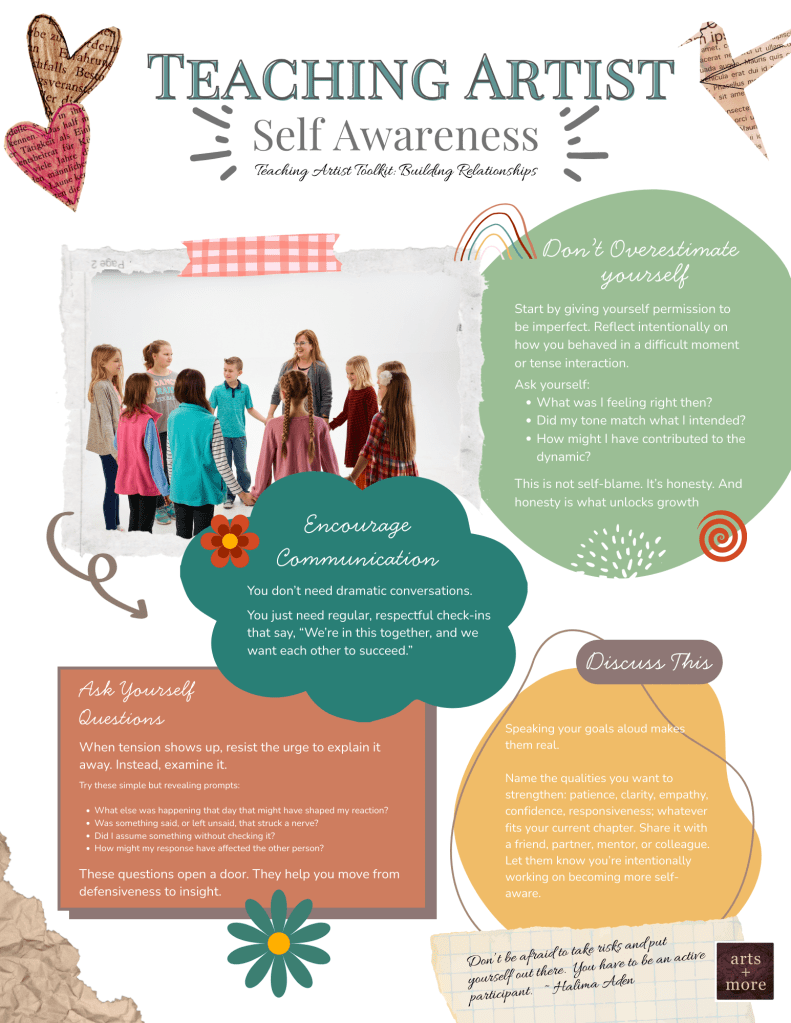
1. Don’t Overestimate Yourself (Or Underestimate Your Influence)
It’s surprisingly easy to assume we see ourselves accurately. Yet we often judge others for lacking self-awareness while overlooking our own blind spots.
Start by giving yourself permission to be imperfect. Reflect intentionally on how you behaved in a difficult moment or tense interaction. Ask yourself:
- What was I feeling right then?
- Did my tone match what I intended?
- How might I have contributed to the dynamic?
This is not self-blame. It’s honesty. And honesty is what unlocks growth.
2. Make Communication a Two-Way Street
Healthy professional relationships are built on balanced communication—not monologues, not swallowed frustrations, and not silent simmering.
No one enjoys giving critical feedback, especially to someone they respect. But strong, resilient teams create space for both celebration and honest correction. Encourage your teaching partners, administrators, and classroom collaborators to speak openly with you—and model the same courtesy in return.
You don’t need dramatic conversations. You just need regular, respectful check-ins that say, “We’re in this together, and we want each other to succeed.”
3. Ask Yourself Real Questions (Not Easy Ones)
When tension shows up, resist the urge to explain it away. Instead, examine it.
Try these simple but revealing prompts:
- What else was happening that day that might have shaped my reaction?
- Was something said, or left unsaid, that struck a nerve?
- Did I assume something without checking it?
- How might my response have affected the other person?
These questions open a door. They help you move from defensiveness to insight.
4. Talk About It, Out Loud, With Someone You Trust
Speaking your goals aloud makes them real.
Name the qualities you want to strengthen: patience, clarity, empathy, confidence, responsiveness; whatever fits your current chapter. Share it with a friend, partner, mentor, or colleague. Let them know you’re intentionally working on becoming more self-aware.
It feels vulnerable, but vulnerability builds connection. You may be surprised by how many people respond with warmth, support, and “me too.”
5. Seek Perspective Beyond Your Own Viewpoint
Understanding how others experience you is a cornerstone of emotional intelligence.
Choose two people (one colleague and one friend) whose judgment you trust. Ask them for honest, specific feedback about how you show up in relationships or collaborations. You don’t need to accept every comment as absolute truth. People see through their own filters.
But when you gather feedback from multiple sources and sit with it thoughtfully, patterns emerge. And patterns can point to important breakthroughs.
You can be comfortable with who you are and open to other perspectives at the same time. That balance is the hallmark of emotional maturity.
The Bigger Picture: Why This Matters for Transient Careers
For educators whose work is stable and ongoing, relationships develop gradually. But teaching artists and itinerant educators often build trust in fast-forward: ten-day intensives, three-month residencies, back-to-back environments, new administrators, new students, new expectations.
Self-awareness stabilizes that instability.
It anchors you.
It protects your energy.
It elevates your professionalism.
And it strengthens every partnership you enter.
When you walk into a school or residency grounded in who you are, aware of your habits, and open to growth, you set the tone. Students sense your steadiness. Colleagues feel safer around you. Administrators view you as a collaborator they can trust.
It’s not about perfection. It’s about presence.
Final Thoughts: The Work Is Worth It
Developing self-awareness is not a quick fix or a one-time achievement. It’s an ongoing practice that’s quiet, steady, and deeply humane.
It helps you:
- navigate complex relationships with confidence
- collaborate with flexibility
- connect to students more compassionately
- recognize your own patterns without judgment
- grow professionally in ways that last
Most importantly, it keeps you authentic in spaces that ask a great deal from you.
Educators and teaching artists change lives every day. The more centered, self-aware, and open-hearted you are, the more profoundly you can do your work…
…wherever you go next!
Ready to bring consistency, trust, and impact to your work?
I invite you to download the Self Awareness Worksheet from the Teaching Artist Toolkit for practical tips to clarify your goals, identify barriers, and create an action plan for forward movement…
…WHICH MEANS you’ll start showing up with intention for your students and your creative projects today.
If you’ve found value in this work, I would love to hear from you. A short testimonial, Google review, or comment helps me improve and allows others to see the difference we’re striving to make together.

Leave a comment