
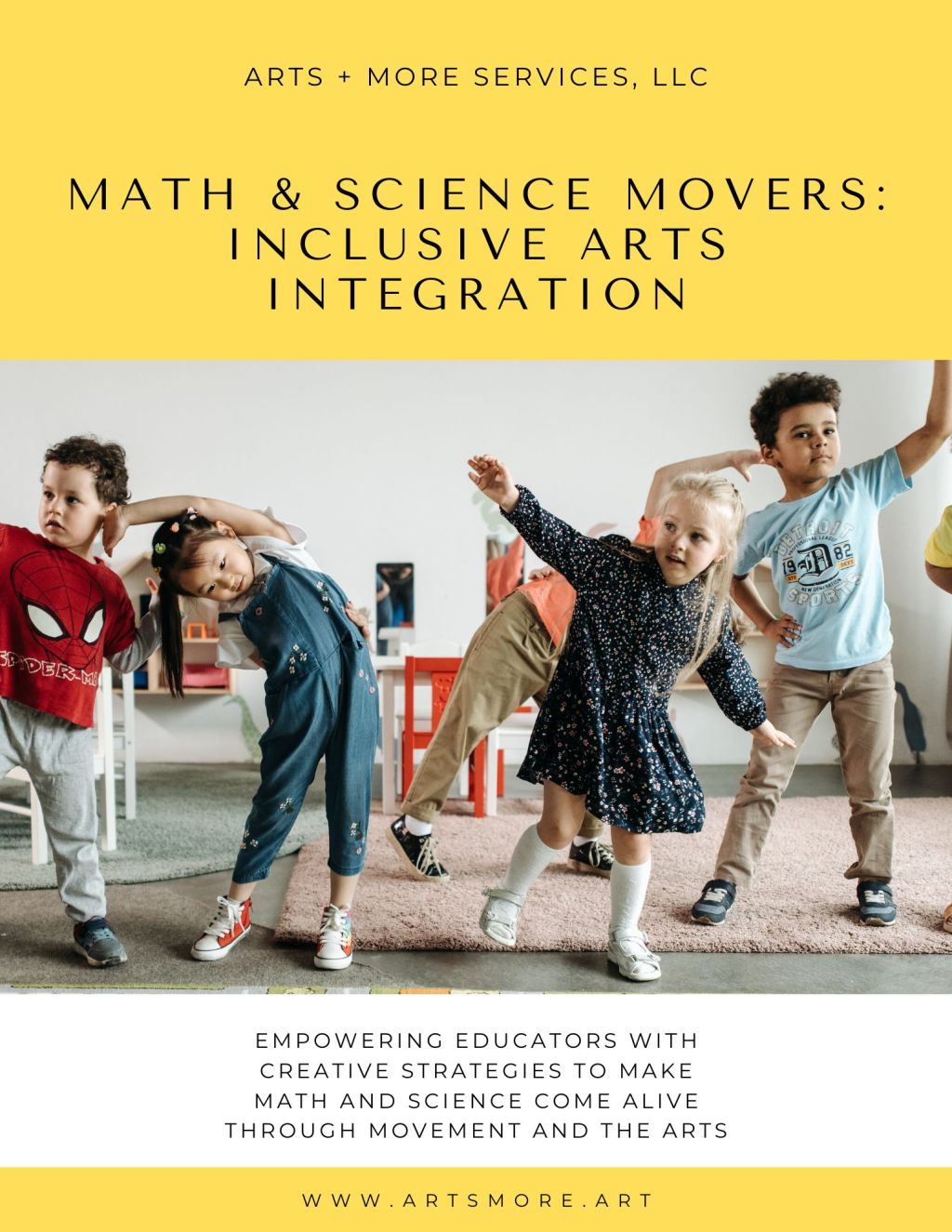
I’m thrilled to be preparing for the Leadership Exchange in Arts and Disability (LEAD®) Conference in Cleveland. LEAD, part of the Kennedy Center’s Access/VSA International Network, is one of the most important gatherings for those working to advance inclusion in the arts. It brings together leaders, educators, administrators, and artists who believe that the arts should welcome everyone. Together, we share resources, exchange ideas, and develop practical strategies for making arts and culture fully accessible to people with disabilities.
This year, I’ll be presenting Math & Science Movers: Inclusive Arts Integration. At its core, this work rests on three guiding principles: Accessibility, Play, and Purpose. When students move, they aren’t just learning steps or shapes—they are building a vocabulary of movement that helps them connect with academic content, express themselves more fully, and support one another in the process. I’ve seen students light up when they realize that a step forward can mean addition, a step back subtraction, or a spin rotation in geometry. Suddenly, concepts that felt abstract come alive in their bodies.
Why does this matter? Research from Cambridge University shows that children learn more through guided play than through teacher-led instruction. Play sparks curiosity, creates positive emotions, and encourages collaboration. In the classroom, this means students are not only learning faster but also encouraging their peers—including students with disabilities—to join in and succeed. Movement becomes a bridge to academic learning, social-emotional growth, and inclusion.
For me, this work is personal. As a choreographer and teaching artist, I have always known that dancing ignited my mind. What I didn’t know then was just how much of the brain lights up when we move: the motor cortex, cerebellum, basal ganglia, somatosensory cortex, auditory and visual processing centers—each working together to plan and execute motion. Today, I see the same spark in students when math and science are no longer confined to a page but embodied in motion.
I look forward to joining colleagues at LEAD to share these strategies and learn from the amazing work happening across the country. Together, we can keep asking the big question: How can movement help us see more clearly, connect more deeply, and grow in ways that matter?

If this sparks your curiosity, I’d love for you to try it yourself. You can download a free copy of the Math & Science Movers Inclusive Arts Integration Course and begin exploring how movement can transform learning in your own classroom or community.
Click here for your free copy.
Discover new ways to bring learning to life with Math + Science Movers by Arts + More Services. This approach uses movement to make abstract concepts tangible, playful, and inclusive—helping every student engage, belong, and thrive. Explore practical resources, lesson ideas, and strategies designed for the classroom.
Visit the Math + Science Movers website today and see how movement can transform your teaching.



Leave a reply to Enhancing Accessibility at Buckeye Book Fair: Insights from LEAD Cancel reply