
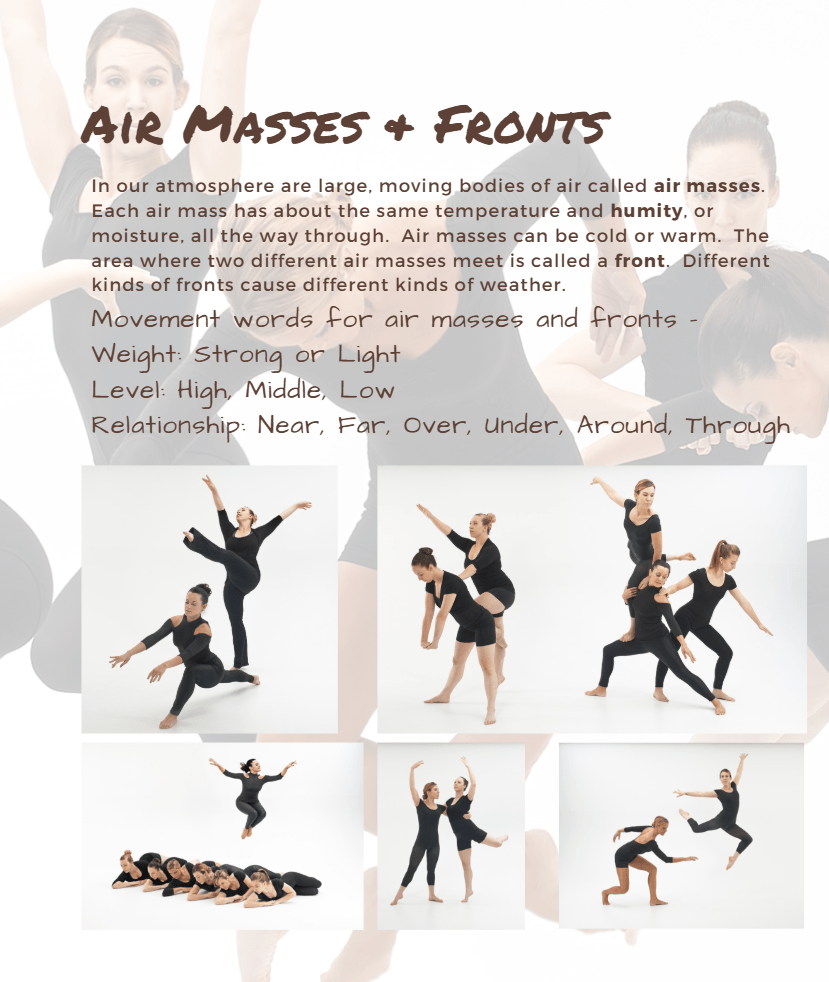
While air seems invisible, it is a physical substance with varying density and characteristics. In this lesson, students will use the elements of dance, specifically Space (levels) and Energy (tension/weight), to embody the five layers of Earth’s atmosphere. By translating scientific data into choreography, students internalize how gravity and temperature create distinct atmospheric zones.
Grade Level Grades 3–6
Duration 45 minutes
Science Standards
- 6.ESS.4: The atmosphere is a mixture of gases that has properties that can be measured.
- 6.ESS.5: The atmosphere has different layers, each with its own characteristics.
Ohio Dance Standards (Grades 3–6):
- Creating: 3.CR.1 / 4.CR.1 / 5.CR.1 / 6.CR.1: Use the elements of dance (space, time, energy) to express an idea or concept.
- Performing: 4.PR.3 / 6.PR.2: Demonstrate control, coordination, and the ability to move through different levels and pathways.
- Responding: 5.RE.1: Describe how the use of dance elements communicates the intent of a dance (e.g., how “heavy” movement represents high pressure).
- Connecting: 3.CO.1 / 6.CO.1: Relate dance to another discipline (Science).
Essential Questions
- How can changes in “Dance Energy” represent changes in air pressure?
- Why does the atmosphere settle into layers rather than staying a single mix of gases?
Learning Objectives
- Students will identify the five layers of the atmosphere in the correct sequence.
- Students will differentiate between high-density and low-density air through physical proximity and speed of movement.
Success Criteria (I can statements)
- I can perform a movement sequence that shows the difference between the Troposphere and the Exosphere.
- I can identify which layer contains the ozone and which layer contains the weather.
- I can cooperate with a group to create an “Atmospheric Stack.”
Vocabulary Words
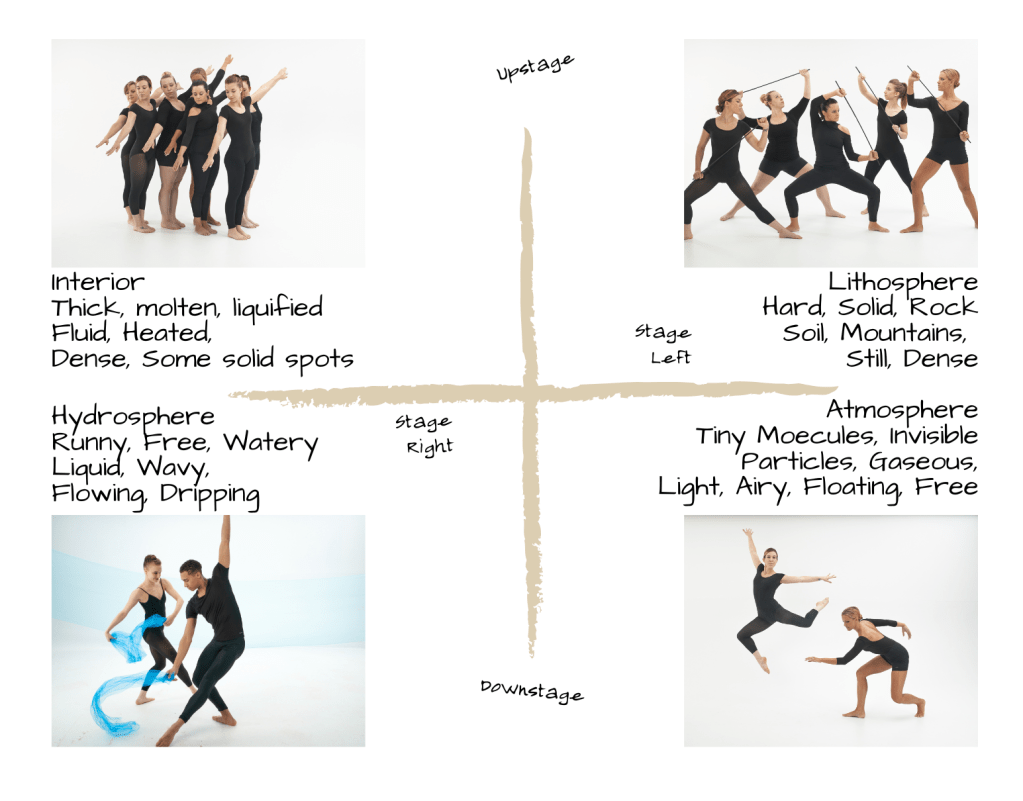
- Upstage: Refers to the back of the stage (away from the audience).
- Downstage: Refers to the front of the stage (closer to the audience).
- Heavy Movements: Dance actions performed with strong weight, firm tension, and a sense of gravity; used to represent the high air pressure and high density of the
- Light Movements: Movements performed with a buoyant, delicate, or airy quality, using minimal force; used to represent the low pressure and “thin” air of the Exosphere.
- Low Movements: Actions performed at a “low level,” meaning close to or on the floor (crawling, crouching); represent the atmospheric layers closest to Earth’s surface.
- High Movements: Actions performed at a “high level,” reaching toward the ceiling or jumping; represents the uppermost reaches of the atmosphere.
- Troposphere: The densest layer, where we live.
- Stratosphere: Contains the ozone layer; stable air.
- Mesosphere: The coldest layer; protects Earth from meteors.
- Thermosphere: The hottest layer; contains the ionosphere.
- Exosphere: The thin outer edge of the atmosphere.
- Air Pressure: The weight of the atmosphere pressing down on Earth.
Materials List
- Classroom audio system and a playlist with varying tempos (Heavy/Bass-heavy vs. Ethereal/Light).
- Visual chart of the five layers.
- Floor tape or cones to designate “altitudes.”
Lesson Activities
Activity One: The Weight of the Air (Troposphere): Students begin in a “low level” (crouched or near the floor). They move with “Heavy Energy” and “High Density,” staying very close to one another to simulate the high air pressure at sea level. Movements should be restricted and slow-motion.
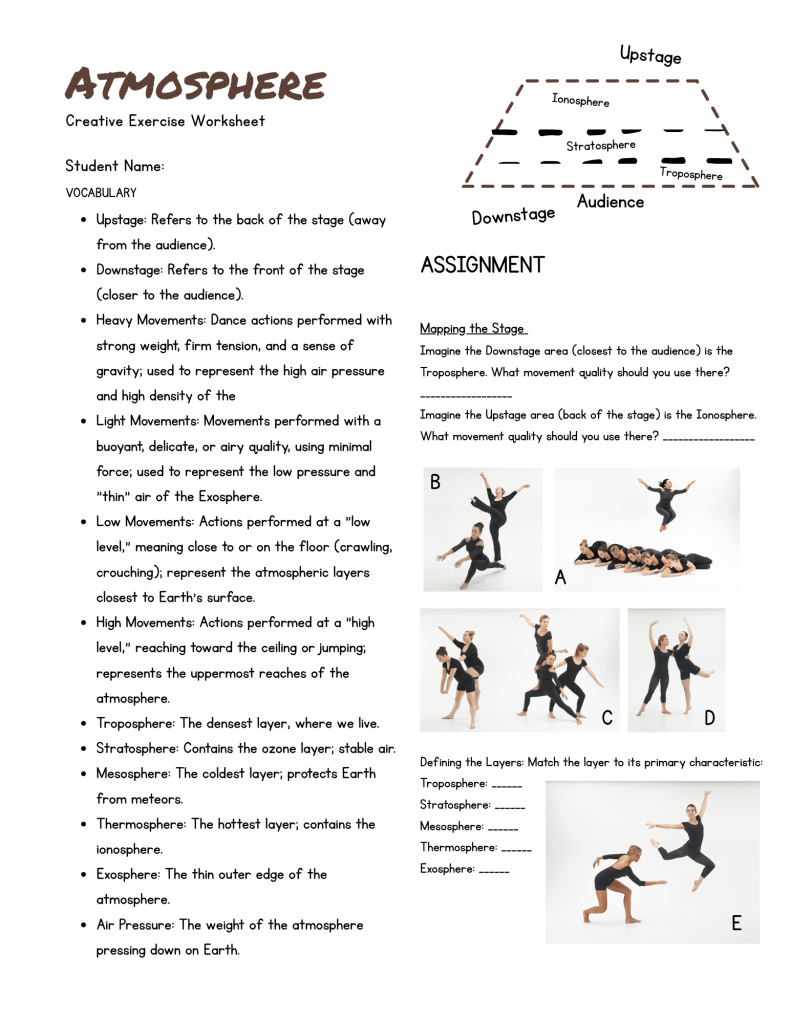
Activity Two: Rising Through the Layers: As the music shifts to a lighter, faster tempo, students “rise” going upstage, through the levels:
- Stratosphere: Glide smoothly (representing jet streams).
- Mesosphere: Sharp, shivering movements (representing the extreme cold).
- Thermosphere: Wide, expansive, vibrating movements (representing high heat and solar energy).
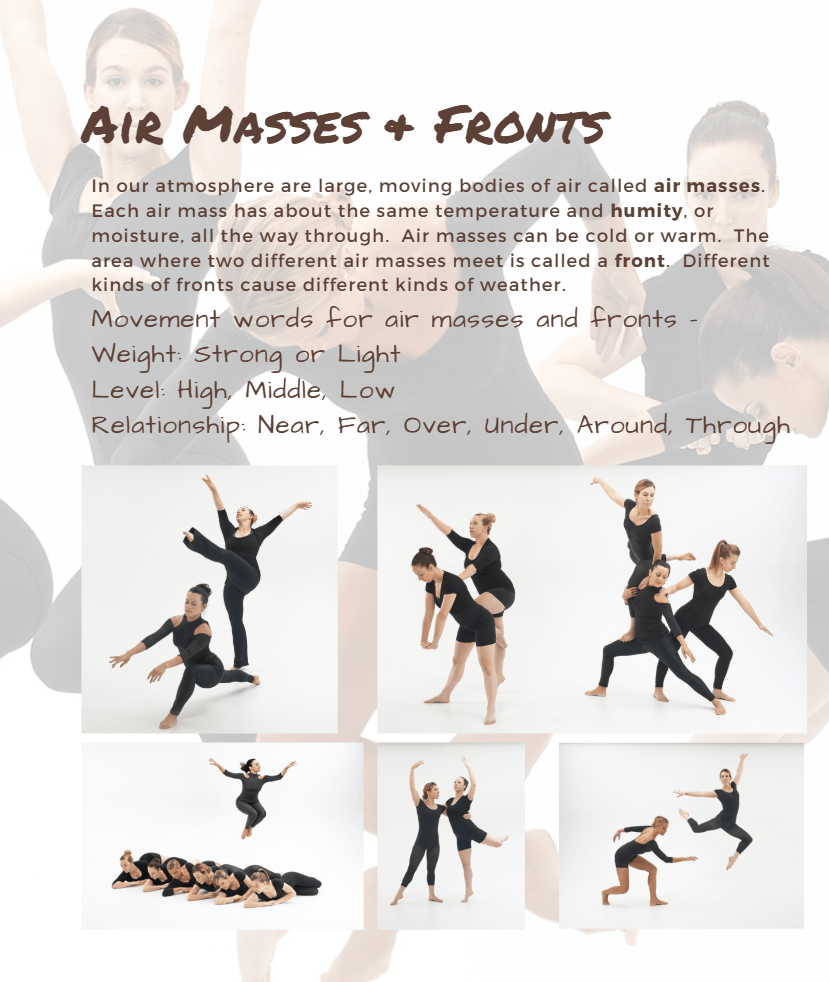
Activity Three: The Small Group Choreography: Divide students into groups of five. Each student is assigned one layer. They must create a 16-count phrase where they start in a “Troposphere” huddle and slowly expand outward and upward until the “Exosphere” student is dancing solo at the edge of the space.
Adaptations and Modifications
Sensory: For students who are sensitive to proximity, use “arm spans” rather than “molecule huddles” to demonstrate density.
Physical: Students with limited mobility can use ribbons or scarves to demonstrate the “thinning” of the air, reaching higher as the layers change.
Assessments
Performance Check: Can students accurately transition from “Heavy/Low” movement to “Light/High” movement as they ascend the atmospheric levels?
Oral Quiz: During the cool-down, ask students to name which “movement layer” was the coldest (Mesosphere) or most crowded (Troposphere).
We conclude by reflecting on how the “Dance of the Molecules” changes based on where they are in the sky. Just as our movements became lighter and more spaced out as we reached for the ceiling, the air molecules in our atmosphere become less “pressed” the further we get from Earth. We end with a collective deep breath, acknowledging the Troposphere air that keeps us moving.


Leave a comment