
This lesson uses dance to help students understand Earth’s four major divisions by embodying their physical properties. Students explore how the Interior, the Lithosphere, the Hydrosphere, and the Atmosphere differ through speed, energy, and movement quality. By traveling through stage quadrants and transforming movement as they cross boundaries, learners deepen comprehension of Earth systems while practicing observation, comparison, and physical expression.
Grade Level
Grades 3–6
Duration
45 minutes
Standards
Science Standards
- Identify and describe Earth’s major systems.
- Compare physical properties of land, water, air, and Earth’s interior.
- Use observation to recognize differences in matter and energy.
Dance Standards
- Creating: Explore movement qualities to represent scientific concepts.
- Performing: Use speed, energy, and body shape to communicate meaning.
- Responding: Observe and describe movement using dance vocabulary.
- Connecting: Relate movement choices to real-world Earth systems.
Essential Questions
- How can movement help us understand Earth’s layers?
- What changes when we move from one system to another?
- How do speed and energy show different environments?
Learning Objectives
- Represent Earth’s four divisions through movement.
- Adjust speed and energy to match scientific properties.
- Observe classmates and identify systems using movement clues.
- Use dance vocabulary to describe what is seen.
Success Criteria
- I can move differently for each Earth division.
- I can change my speed and energy when crossing zones.
- I can observe classmates and explain what system they show.
- I can use movement words to describe what I see.
Vocabulary
- Interior: The inside of the Earth, thick and heated.
- Lithosphere: Solid land made of rocks and soil.
- Hydrosphere: All the water on Earth.
- Atmosphere: The air surrounding Earth.
- Speed, Energy, Level, Flow, Density, Body Shape
Materials
- Large open space or stage
- Floor tape or cones to mark four quadrants
- Earth system word cards (optional)
- Observation sheets or clipboards
Lesson Activities
Activity One: Mapping the Biosphere
Explain that Earth has four divisions: Interior, Lithosphere, Hydrosphere, and Atmosphere. Divide the stage or room into four quadrants: upstage, downstage, stage left, stage right. Assign each quadrant a system.
Review movement qualities:
Interior
Thick, molten, liquefied, fluid, heated, dense, some solid spots
Lithosphere
Hard, solid, rocks, soil, mountains, still, dense
Hydrosphere
Runny, free, watery, liquid, wavy, flowing, dripping
Atmosphere
Tiny molecules, invisible particles, gaseous, light, airy, floating, free
Students begin in one quadrant and improvise movement based on that system.
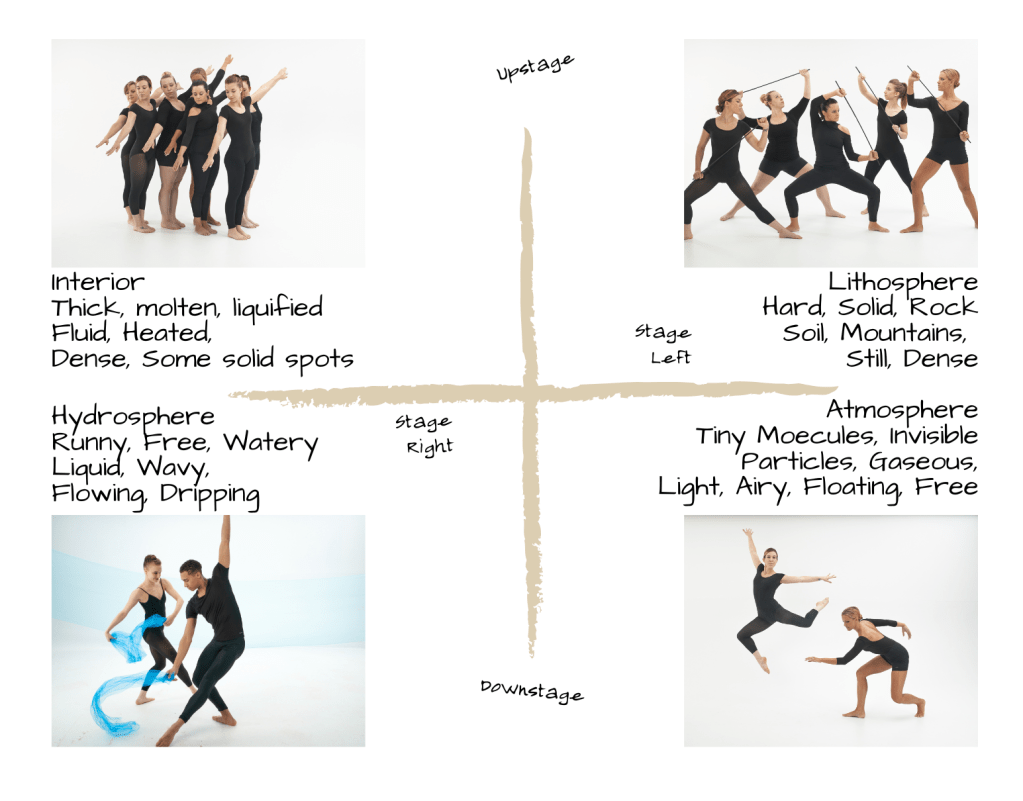
Cue students to cross dividing lines. Each time they enter a new quadrant, they must instantly transform their speed and energy to match the new Earth division.
Pause periodically to spotlight strong examples.
Activity Two: Observation Assignment
Students travel freely between divisions while half the class observes.
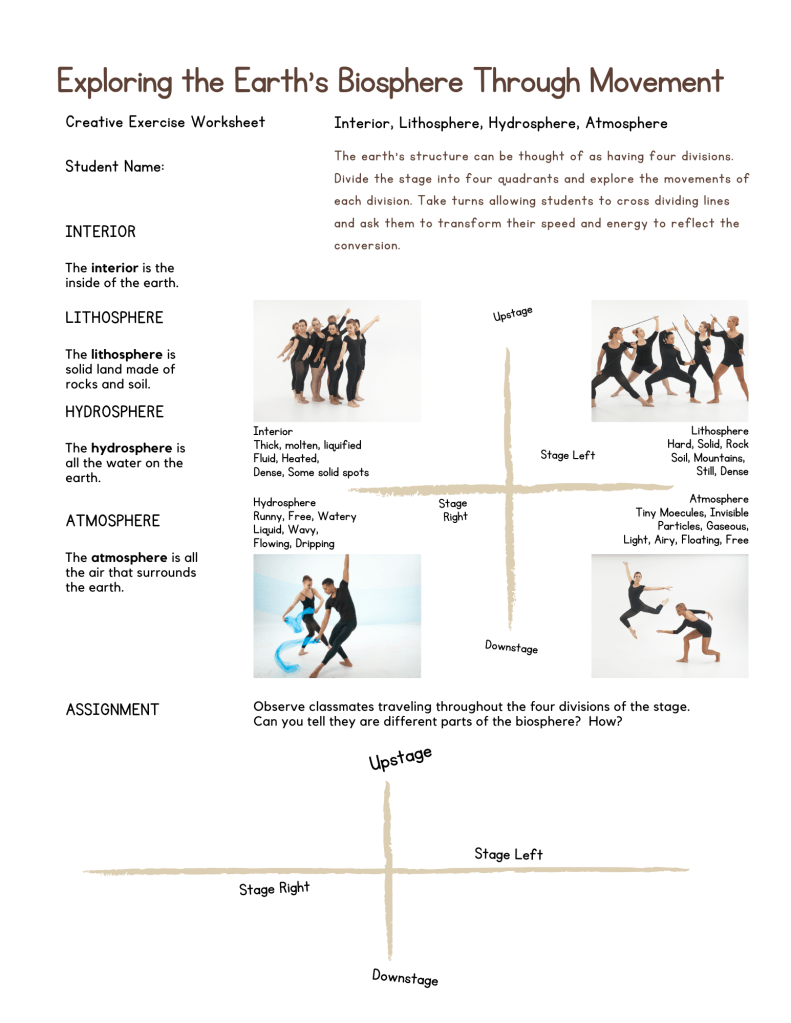
Observers answer:
- What is the dancer’s speed?
- What is the dancer’s energy?
- Which Earth system do you think they are showing? Why?
Rotate roles.
End with a group reflection: Can you tell the systems apart through movement alone? What clues helped most?
Adaptations and Modifications
- Provide word banks or picture cards for each system.
- Allow seated or upper-body-only movement.
- Offer drawing instead of writing.
- Model each division before students explore independently.
Assessment
Formative Observations
Are students changing speed and energy between zones?
Can students identify systems through movement?
Student Work Samples
Observation notes or drawings
Completed prompts: “I noticed ___ so I think ___.”
Reflection Prompts
Which Earth division felt easiest to show?
What movement helped you recognize Hydrosphere or Atmosphere?
How did changing speed and energy change your understanding?
This lesson reinforces scientific understanding by turning Earth’s systems into lived, physical experiences. By embodying the Interior, Lithosphere, Hydrosphere, and Atmosphere, students move beyond memorization and into meaningful application, using speed, energy, and observation to distinguish each division. The act of crossing boundaries strengthens their ability to recognize change, compare properties, and communicate ideas through movement. Students practice close observation, build descriptive language, and deepen conceptual awareness while collaborating with peers. Most importantly, they learn that science is not just something we read about, it is something we can feel, explore, and express through our bodies.



Leave a comment