
Have you ever picked up a book everyone swears you’ll love, only to find yourself half an hour in thinking, “This just isn’t for me…” but you keep reading anyway?
That’s how I feel about email. If it’s not valuable, it’s not worth your time. So today, I’m skipping the fluff and going straight to what matters: real research showing how the arts improve our lives and how you can use that knowledge to build supportive, positive learning environments.
WHICH MEANS you get the facts and get to work.
Why the arts matter…
Let’s look at the evidence: the arts aren’t just for fun or decoration. They play a serious role in helping people feel better, grow stronger, and learn more deeply.
Art Reduces Stress
- In a study where 39 adults spent 45 minutes creating free-form art, approximately 75% had lower cortisol (a stress hormone) levels by the end of the session.
- The drop in cortisol didn’t depend on how skilled someone was with art.
- Participants also reported better mood, more confidence (self-efficacy), and a feeling of being freed from worries.
So you don’t need to be “good” at drawing or painting. Simply creating something, even loosely, can calm your body and mind.
Arts strengthen psychological well-being
- In studies of university students, those who engage in fine arts courses show better psychological well-being.
- Engagement in the arts is linked to higher self-efficacy and creativity, which further support positive mental health.
How do I help my boss understand?
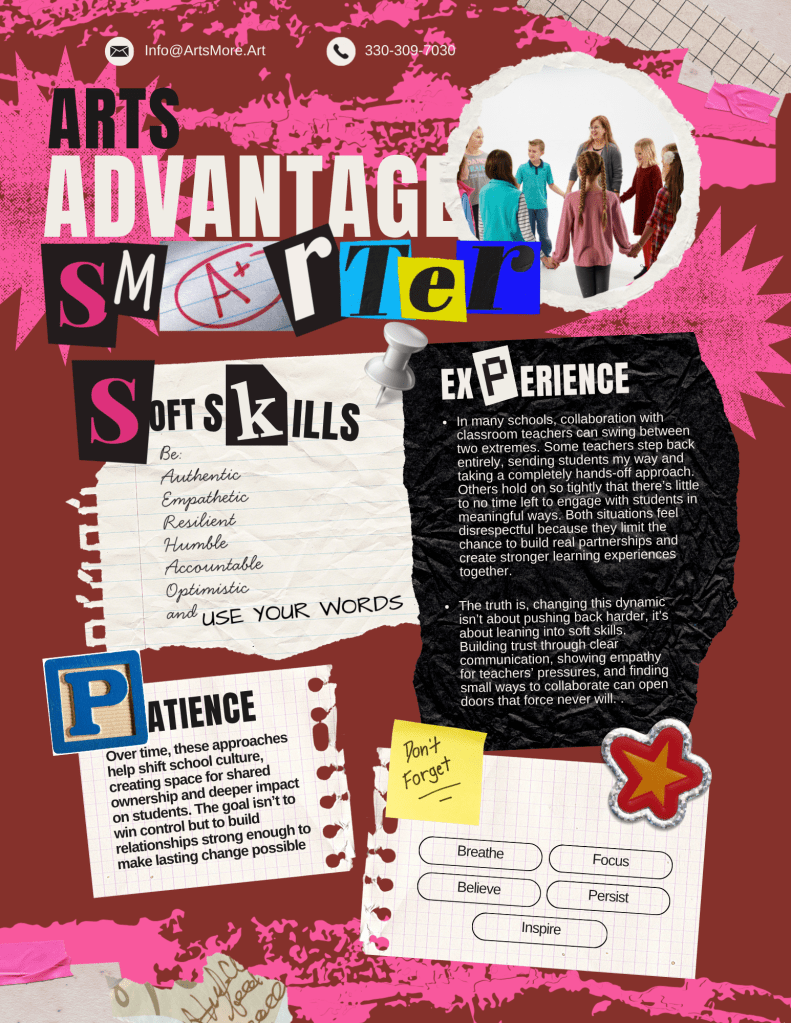
Soft skills like communication, empathy, collaboration, and problem-solving are essential for communicating with administrators and leaders. These skills build trust, strengthen teamwork, and create positive school cultures. They help leaders listen, respond to needs, and guide change effectively. When leaders model soft skills, they set the tone for creativity, respect, and cooperation across the whole learning community.
Skills that Matter…
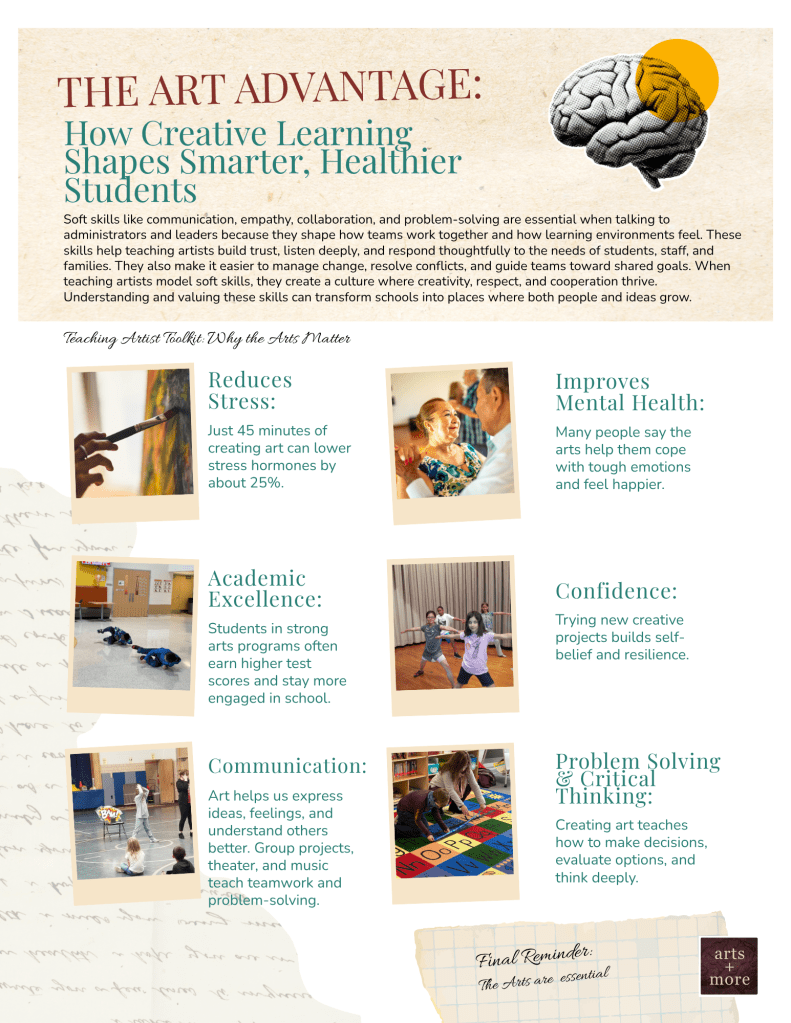
The arts help build many skills that matter in school and life:
- Academic excellence / critical thinking / problem solving
Schools with stronger arts programs see increases in writing scores, greater student engagement, and fewer disciplinary incidents.
Arts education also supports critical historical thinking and deeper understanding of culture by offering new perspectives. - Cultural awareness & empathy
When students explore works of art or tell stories, they step into someone else’s shoes. That builds empathy.
A recent study of medical students found that those engaged in art practices scored higher on empathy measures than their peers. - Confidence (self-efficacy)
As people make something, try ideas, and see growth, they often feel more capable. In the 45-minute art study, participants reported increased confidence in facing new challenges. - Collaboration, cooperation, communication
Many art forms are social think group projects, theater, and ensemble music. They require communication, compromise, shared decisions. - Creativity / innovation
Art encourages imagining alternatives, taking risks, experimenting, and thinking “What if?” That mindset carries over to solving academic or life problems. - Cooperation / teamwork
In group art tasks, people must listen, adapt, coordinate. These experiences mirror working on projects or solving issues together. - Communication
Art is a language: visual, verbal, movement. It helps people say things they find hard to express. It also teaches people to interpret others’ expressions.
Download Your Teaching Artist Toolkit
Ready to bring consistency, trust, and impact to your work? Download this page of the Teaching Artist Toolkit for practical tips, reflection prompts, and action steps you can use right away….
WHICH MEANS you’ll start showing up with intention for your students and your creative projects today.
The evidence is clear: the arts are far more than enrichment. They are essential to mental health, academic growth, social connection, and lifelong skills. By weaving the arts into learning spaces, we nurture creativity, empathy, confidence, and collaboration in ways that traditional methods alone cannot. In my next post, we’ll look at how schools and learning spaces can integrate arts in practical, lasting ways, how to measure their impact, and the soft skills required to share this knowledge effectively. If you’ve found value in my work, I would love to hear from you. A quick testimonial, whether through a Google review, a comment, or a site rating, helps me improve and allows others to see the difference we are working to make.

References
American Academy of Arts & Sciences. (n.d.). The values of arts education. In Art for life’s sake.
Bowen, D. H., & Kisida, B. (2023). The fine art of school engagement: How expanding arts education affects learning, behavior, and social-emotional growth. Education Next, 23(3), 48–54.
Fornetti, M., & Barbosa, M. (2024). The association between empathy and artistic practice: A cross-sectional study with medical students. BMC Medical Education, 24, 1156. https://doi.org/10.1186/s12909-024-06146-y
Jin, X., & Ye, Y. (2022). Impact of fine arts education on psychological wellbeing of higher education students through moderating role of creativity and self-efficacy. Frontiers in Psychology, 13, 957578. https://doi.org/10.3389/fpsyg.2022.957578
Kaimal, G., Ray, K., & Muniz, J. (2016). Reduction of cortisol levels and participant responses during artmaking.

Leave a comment