
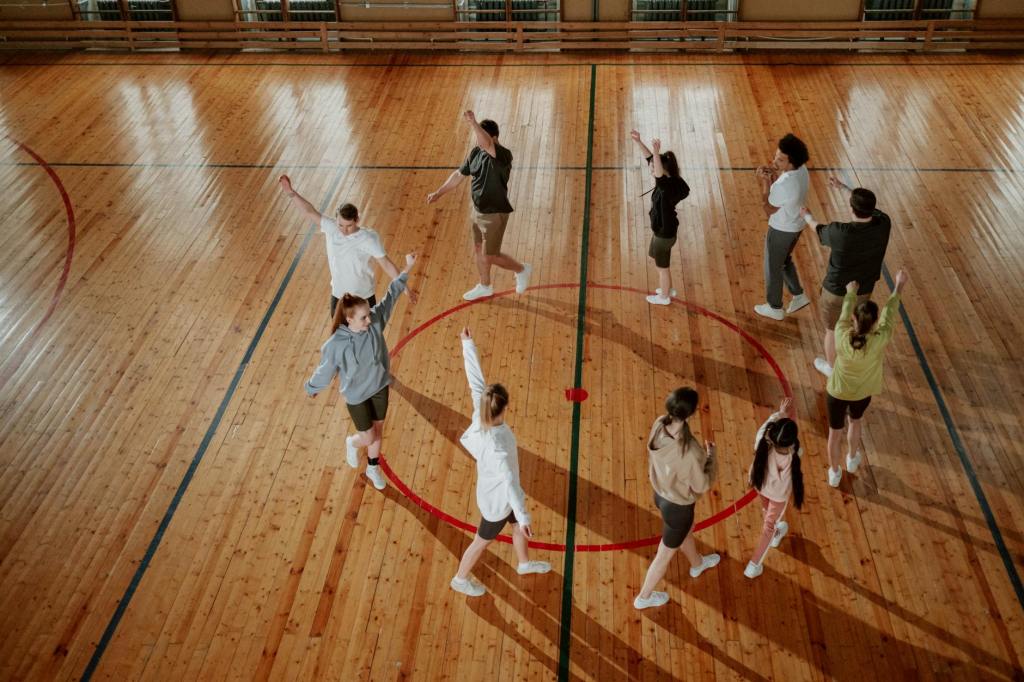
Circle dances are among the oldest known forms of dance, practiced across cultures to mark special occasions, foster community, and celebrate shared heritage. While students have learned about Pi and are celebrating Pi Day (3/14), this is a natural tie-in. These dances often involve simple steps, making them accessible to large groups and serving important cultural functions from ancient rituals to modern festivals. Incorporating circle dances into the classroom not only brings joy and movement but also offers a rich tapestry of global traditions to explore.
Why Circle Dances Matter in Education
Incorporating circle dances into the classroom offers numerous educational benefits:
- Cultural Awareness: Students gain insight into global traditions and histories.
- Community Building: Shared movement fosters a sense of unity and cooperation.
- Physical Activity: Dance promotes physical health and coordination.
- Emotional Expression: Movement allows students to express emotions and connect with peers.
A Classroom-Friendly Circle Dance: Geometry in Motion
One engaging activity for students combines circle dance with math concepts. In this lesson, students hold hands and follow a simple choreography:
- 8 steps around to the right
- 8 steps around to the left
- 8 steps into the center for radius
- 8 steps away from the center for radius
- 8 counts for person one to make a chord
- 8 counts for person two to make a chord
- 8 counts for people three and four to show the diameter
- 8 counts for person five to go on a tangent and return
Then the next five students repeat the sequence. This movement-based approach makes abstract geometry tangible while letting students collaborate and have fun.
Examples of Circle Dances from Around the World
- Hora (Balkans/Israel): Known in Southeastern Europe as hora, khoro, or oro, this dance was introduced to Israel and is now a symbol of Jewish and Israeli folk dance. The hora is a traditional Jewish wedding dance that serves as a festive celebration of a newlywed couple’s union. Typically performed early in the wedding reception, the dance involves guests forming a circle while the couple—and sometimes immediate family—are lifted on chairs. This communal, high-energy ritual is usually accompanied by the song “Hava Nagila” .
- Faroese Dance (Faroe Islands): A national dance dating back to medieval times, once banned elsewhere in Europe, preserved today as a cultural treasure. The Faroese chain dance is the national circle dance of the Faroe Islands, accompanied by kvæði, the Faroese ballads. The dance is danced traditionally in a circle, but when there are many dancers, they usually let it swing around in various wobbles within the circle .
- Garba (India): Performed during Navratri in Gujarat, this lively circle dance celebrates the mother goddess. Garba is a traditional social dance from Gujarat, India, performed during the Hindu festival of Navratri in celebration of the mother goddess .
- Dabke (Levant): A folk dance from Lebanon, Syria, Jordan, and Palestine, performed in lines or circles with vibrant energy. Dabke is a well-known Levantine folk dance performed in a line or circle by people in countries like Lebanon, Syria, Jordan, and Palestine .
- Kochari (Armenia): Participants link arms in a circle, performing vigorous and coordinated steps. Kochari is a traditional Armenian folk dance where participants link arms in a circle to perform vigorous movements .
- Native American Round Dance: A long-standing tradition among various tribes, highlighting community, ritual, and celebration. The ancient Maya maize god was a god of dance. And, to this day, unique forms of ritual, ceremonial and social dancing maintain a vital place in contemporary community life .
- Samba (Brazil): Originating in Rio de Janeiro, early samba was performed in circles with drumming, forming a key part of Brazilian culture. Samba is a Brazilian dance with African roots that was initially a circle dance accompanied by drumming that became a symbol of Brazilian culture .
- La Danza del Sol (Mexico): An Aztec ritual circle dance with layered structure, representing cosmic views. La Danza del Sol is an ancient ritual performed by the Aztecs, this circle dance represents their cosmic views and has a layered structure that allows for easy learning .
- Guozhuang (Tibet): A Tibetan folk dance featuring simple steps, allowing wide community participation. Guozhuang is a Tibetan folk dance that is a common style of folk dancing, featuring simple steps that allow for broad community participation .
Incorporating Circle Dances into the Classroom
Educators can introduce circle dances as part of cultural studies, physical education, or math lessons. Here’s how:
- Research: Explore the history and significance of a circle dance from a chosen culture.
- Learn: Teach students the steps and music associated with the dance.
- Reflect: Discuss the cultural context and meaning behind the dance.
- Perform: Organize a class performance to celebrate the learned dance.
Conclusion
Circle dances are more than just fun activities; they are windows into the rich tapestry of global traditions. By incorporating these dances into the classroom, educators provide students with opportunities to learn about different cultures, engage in physical activity, and build a sense of community. So, gather your students, form a circle, and let the dance begin!

Leave a comment