
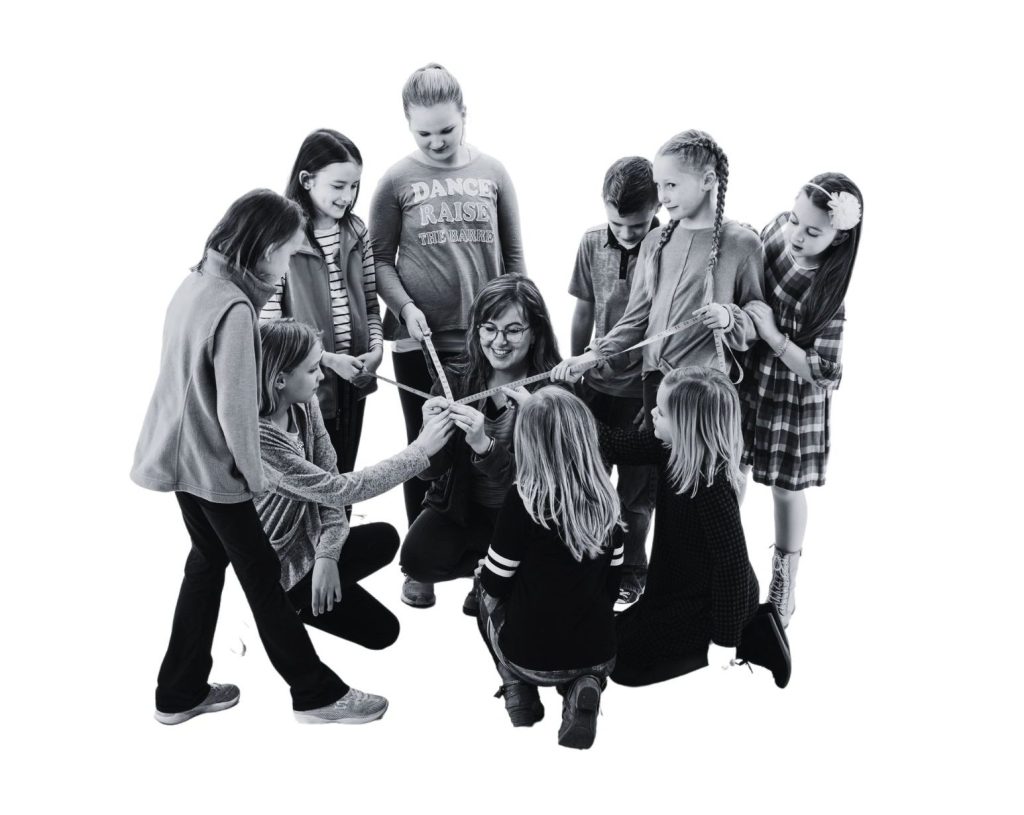
Understanding the parts of a circle: radius, diameter, chords, tangents, and the constant pi can feel abstract when studied only on paper. This lesson brings those concepts to life through movement, encouraging students to embody mathematical figures. Using dance, students choreograph sequences to represent geometry terms, making math tactile and meaningful. As students move together, they also experience the artistic process of choreography: a series of designed motions that occur in sequence using their physical bodies as mathematical figures.
Grade Level: 4–6
Duration: 45–60 minutes
Standards
- Math:
- Convert among different-sized standard measurement units within a given measurement system.
- Know the formulas for the area and circumference of a circle and use them to solve problems.
- Dance:
- Creating: Create structured movement phrases that explore spatial relationships, such as radii and chords within a circle.
- Performing: Demonstrate movement with clear intent using geometric patterns and directional changes to represent radius, diameter, and tangent lines.
- Responding: Analyze and describe how movement can symbolize mathematical principles like symmetry and proportion in circular choreography.
- Connecting: Explain how math connects to dance by modeling shapes and relationships within a circle using choreography and group movement.
Essential Questions
- How can our bodies show the parts of a circle?
- In what ways does movement help us understand pi?
- What do our movements tell us about the relationship between math and dance?
- What does it mean to choreograph a mathematical concept?

Learning Objectives
- Define and demonstrate key circle terms: radius, diameter, chord, tangent, and pi.
- Use the body to model geometric relationships and terms through movement.
- Collaboratively create and perform a choreographed “circle dance” that expresses mathematical concepts.
Success Criteria
- I can use my body to show a radius, diameter, and chord.
- I can explain and demonstrate how a tangent touches the circle at one point.
- I can participate in a circle dance choreography that models geometric concepts clearly.
Vocabulary
- Circle: A set of points in a plane, all the same distance from a given point (the center).
- Center: The middle of the circle.
- Radius: A line segment from the center to any point on the circle. (Plural: radii)
- Diameter: A chord that passes through the center of the circle.
- Chord: A line segment that joins any two points on the circle.
- Tangent: A line that touches the circle at exactly one point.
- Circumference: The distance around the circle.
- Choreography: A series of designed motions that occur in sequence using students’ bodies as mathematical figures.
Materials
- Long rope or hula hoops (circles)
- Yardsticks or measuring tapes
- Chalk or tape for marking space
- String segments labeled as “radius”
- Visual diagrams of circles
- Music or rhythmic clapping for circle choreography
- Optional: compasses or tracing templates for visual follow-up
- Optional: devices (phones/tablet) to record movement for reflection
Lesson Activities
Activity One: Introduction
- Introduce each circle term with visuals and body modeling.
- Demonstrate each with real objects (pizza = circle, bracelet = circumference).
- Have students mirror radius and diameter with their arms.
Activity Two: Circle Construction with Rope
- Have students create a large circle by using their tape measures or ribbons cut in the same length.

Activity Three: Creating & Performing: Radius Modeling
- One student holds string at center; another walks outward to edge marking radius.
- Rotate roles; students notice body orientation while moving from center to edge.
Activity Four: Modeling Diameter
- Walk string across fully through center.
- Create different movement qualities (longer stretch, different speed/direction).
Activity Five: Embedding Pi through Movement
- Use radius-length string to step around circle to approximate circumference.
- Count “radii” steps (~3.14).
- Discuss how movement experience reflects pi’s constancy regardless of circle size.
Activity Six: THE CIRCLE DANCE

Circle Dance Choreography: Holding hands
- 8 steps around to the right
- 8 steps around to the left
- 8 steps into the center for radius
- 8 steps away from the center for radius
- 8 counts for person one to make a chord
- 8 counts for person two to make a chord
- 8 counts for people three and four to show the diameter
- 8 counts for another person five to go on a tangent and come back.
- Repeat using the next five people in the circle.
Activity Seven: Connecting
- Explore how circles appear in art (mandalas), nature, and cultural dance formations.
- Optionally sketch or dance-inspired drawing using compasses.
Adaptations and Modifications
Learner Needs Addressed
- Designed for students with visual or hearing impairments, sensory processing challenges, autism spectrum disorder, and fine or gross motor coordination difficulties.
- Also supportive for English language learners (ELLs) and students with learning disabilities related to math vocabulary or spatial reasoning.
Adapted Materials / Tools
- Provide tactile 3-D models of circles and parts (foam discs, yarn for radii, textured lines for chords and tangents).
- Use large-print, high-contrast diagrams with labeled parts of the circle for students with low vision.
- Supply visual vocabulary cards with images and simple definitions for terms like radius, diameter, chord, and tangent.
- Offer noise-canceling headphones, visual timers, or quiet zones for students with sensory sensitivities.
- Use manipulatives like rubber bands and geoboards or string-and-pin boards to help students model circle parts with their hands.
- Allow digital diagram tools or drawing apps for students who struggle with fine motor skills or writing.
Instructional Strategies
- Introduce each geometry term with consistent repetition, gestures, and movement cues (e.g., tap head for “center,” stretch arms for “diameter”).
- Pair vocabulary with kinesthetic modeling—students form shapes with their own arms or walk out the segment in space.
- Break choreography into small, countable sections (e.g., “8 steps in, 8 steps out”) to support memory and sequencing. Offer step-by-step guided practice before expecting independent participation.
- Reinforce concepts with chants or rhymes (“Radius goes out, diameter goes through!”).
- Allow alternate forms of participation (e.g., pointing or using props instead of walking the circle) when needed.
Peer Support & Grouping Ideas
- • Use peer buddy systems: one student models or narrates while the other participates in movement.
- • Form mixed-ability groups where roles rotate: measurer, mover, narrator, diagrammer.
- • Offer leadership opportunities to students with strengths in movement or verbal skills to support peers with different needs.
- • Encourage reflection in partners or small groups to help verbalize understanding of circle terms and choreography.
- • For ELLs, pair students who speak the same first language or use bilingual supports if available.
Assessment
- Observation Checklist: During the Circle Walk and Choreography, observe students for accurate use of vocabulary (e.g., correctly identifying and demonstrating a radius, chord, or tangent). Use a checklist to note participation, understanding, and ability to apply terms in movement.
- Movement Demonstrations: Ask students to use their bodies to show specific circle parts on cue (e.g., “Show me a diameter with your arms,” or “Where is the tangent on the floor?”).
- Think-Pair-Share Prompts: Ask students to explain the difference between a radius and a chord to a partner, then share out loud. This allows for real-time correction and reinforcement.
- Exit Question: “How did our choreography show the idea of pi?” or “What shape or movement helped you understand a circle best today?”
Circle Dance helped students experience π in a new way—through safe, collaborative movement that integrated dance and math. Students physically embodied the relationships between radius, diameter, and circumference, engaged in artistic expression, and reflected on meaning through dialogue. This approach builds both geometric understanding and dance fluency. Next steps could include choreographing a short movement phrase based on circle parts or designing circular art that reinforces mathematical principles.

Leave a comment