
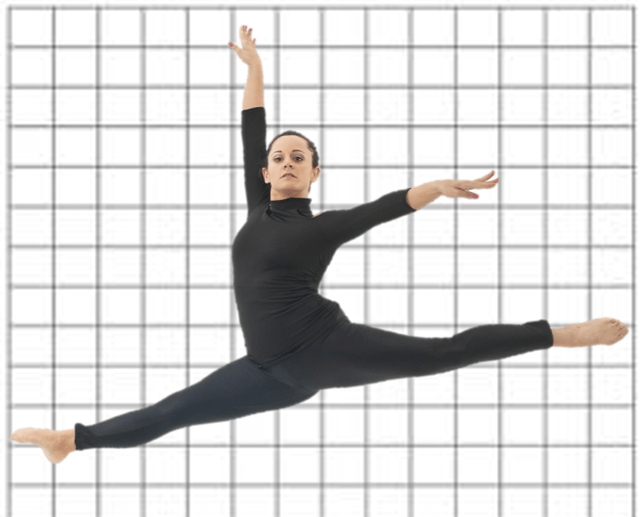
Understanding area becomes more meaningful when students can step inside the shapes they’re measuring. In this active lesson, students become “area units” themselves, exploring the space within rectangles, squares, and compound shapes using their bodies. Through structured movement and visual modeling, students discover how repeated units (like tiles or steps) form the foundation for calculating area. The lesson incorporates dance by connecting body spatial awareness and shape-based design with mathematical measurement.
Grade Level: 2–4
Duration: 45–60 minutes
Standards
- Math Standards
- Understand that area represents the number of square units that cover a surface.
- Relate area to multiplication and addition.
- Solve real-world problems involving area of rectangles and composite shapes.
- Dance Standards
- Creating: Use body shapes and spatial design to explore personal and group space.
- Performing: Demonstrate movement sequences with spatial clarity and repetition.
- Responding: Identify and describe shape and spatial relationships in movement.
- Connecting: Relate concepts of measurement and shape from math to body design in choreography and classroom movement.
Essential Questions
- What is area, and how can we measure it using our bodies?
- How can movement help us understand math concepts like length, width, and space?
- How do we know if a shape has more or less area than another?
Learning Objectives
- Define area as the amount of space inside a shape.
- Use body-based units to estimate and compare area.
- Calculate area of rectangles and L-shaped figures using multiplication.
- Describe movement sequences that model shapes and measurement processes.
Success Criteria
- I can describe area as the space inside a shape.
- I can estimate and count area using movement and tiles.
- I can calculate area using length × width.
- I can move in ways that represent the size and shape of rectangles.
Vocabulary
- Area: The number of square units that cover a surface.
- Square unit: A unit of measurement for area; a square with side length of 1 unit.
- Length: The longer side of a rectangle.
- Width: The shorter side of a rectangle.
- Rectangle: A shape with 4 right angles and opposite sides equal in length.
- Composite Shape (L-shape): A figure made up of two or more rectangles.
- Choreography: A sequence of body movements used to represent or communicate an idea—in this case, a mathematical concept.
Materials
- Masking tape or chalk (to outline large shapes)
- Yardstick or measuring tape
- Optional: foam tiles, large grid paper, or printed area cards
- Graph paper for individual follow-up
- Large Fabric
- Music or rhythmic cues for structured movement

Lesson Activities
Activity One: Body Block Builder
- Use masking tape or chalk to mark a large rectangle on the classroom floor.
- Ask, “How many of our bodies fit inside this shape without overlapping?”
- Have students enter the shape and count—filling it corner to corner with standing or seated bodies.
- Repeat with smaller or differently shaped areas (squares, narrow rectangles, L-shapes).
- Measure the shape’s length and width with a yardstick and calculate area using multiplication.
- Discuss: “Was our estimate close to the calculated area? Why or why not?”
Dance Connection: Students use frozen poses to fill the space, forming a living pattern of square units.
Activity Two: Still on the Floor
- Assign students to small groups with defined taped floor shapes.
- Each group choreographs a “fill-the-space” movement phrase:
- Enter shape with traveling steps
- Spread out to fill evenly (grid or staggered)
- Strike shapes (arms wide = square units)
- Freeze for 4 counts
- Exit and repeat with a new formation
- Narrate as groups perform: “They’re filling 3 rows with 4 dancers… that’s 12 square units!”
- After each performance, ask the audience: “How many units of area did you see? How do you know?”
- Link to drawing tasks—transition from physical models to paper-based area diagrams.
Activity Three: Worksheet for Group Time

- Have a student (or yourself) pose in a rectangular prism shape (arms down by sides, standing tall like a box). This will serve as the 3D model. Imagine them as a solid block.
Optional: Use painter’s tape, string, or imaginary “laser lines” to help outline the shape of the prism around the dancer.
S.A. = 2 X (LXW) front + 2 X (LxW) top + 2 X (LXW) side
2. Work with partners to estimate and record the dimensions:
- Front face: height × width of the body
- Top face: width × depth (shoulder to back)
- Side face: height × depth
You may use string or a measuring tool (yardstick, tape measure) for support.
3. Draw a quick sketch of your dancer in the rectangular shape. Label the front, top, and side rectangles.
Write your multiplication clearly for each set of faces and add up the total surface area.
Adaptations and Modifications
Learner Needs Addressed
• Designed to support students with mobility differences, attention challenges, sensory sensitivities, or visual-spatial processing needs.
• Also beneficial for English language learners (ELLs) and students with limited number sense or emerging spatial vocabulary.
Adapted Materials / Tools
• Offer smaller paper grids and manipulatives for seated modeling (e.g., graph paper, foam tiles, pop-it mats).
• Provide large visuals and simple pictorial cues to define “area,” “row,” and “column.”
• Use tactile floor shapes or textured outlines for students with visual impairments.
• Supply individual dry-erase boards or tablets for drawing grid models.
Instructional Strategies
• Model area concepts using a document camera or whiteboard alongside movement.
• Use rhythmic chants and call-and-response (e.g., “What is area? Space inside!”).
• Repeat physical patterns in place for students who cannot travel across the room.
• Guide transitions between movement and paper representations to support conceptual transfer.
• Explicitly connect multiplication facts to physical rows and columns.
Peer Support & Grouping Ideas
• Pair students with differing strengths: one builds or moves, one counts or explains.
• Create inclusive groups with clearly defined movement roles (enter, count, mark, exit).
• Rotate student leaders who model the transition from movement to math.
Assessment
• Observe students as they move within shapes—can they organize themselves into rows and columns?
• Ask questions during movement:
- “How many bodies fit across?”
- “How many rows did we make?”
- “What is the area in body units?”
• Visual Task: Students draw rectangles and label sides and area (e.g., 4 × 5 = 20 sq. units).
• Reflection Prompt: “How did using your body help you understand area?”
By using their full bodies to measure and fill space, students come to see area as something real and measurable. The Body Block Builder activity makes area visible, while the choreography strengthens retention and builds spatial awareness. This lesson bridges physical movement and math reasoning, giving all learners a chance to understand area through embodied experience. Students leave with the tools to calculate area confidently and creatively, both on paper and on their feet.

Leave a comment