
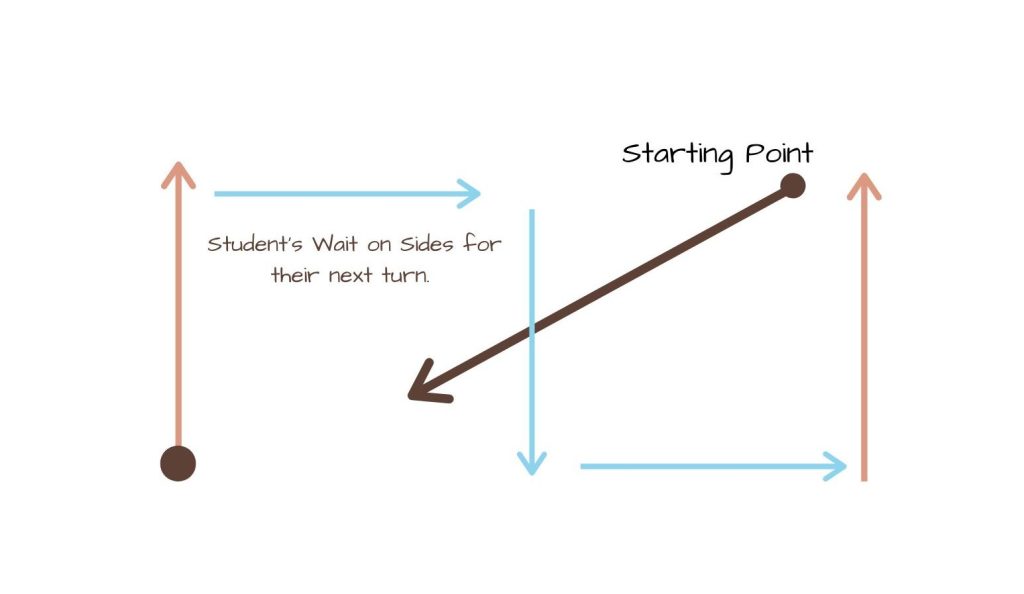
Today, we’re going to practice moving our bodies while exploring an important math idea: pathways. Look down to find your Beginning Vertex marked on the floor. That’s your starting point. Now, look across the room to see the Ending Vertex. That’s your destination.
Using masking tape, we’ve drawn the straight line that connects these two vertices. This line shows the shortest path between them. Your job will be to travel along this pathway using different locomotor skills—walking, hopping, skipping, sliding, or even moving like a robot. Each way of moving helps us understand both how our bodies work and how geometric ideas like lines and vertices connect in space.
As you travel, pay attention: How does your movement change when you shift from walking to hopping? What do you notice about staying “on the line”? Together, we’ll discover how math and science can live in our muscles, not just on paper.
Estimated Duration: 12–15 minutes
Space Needed: Open floor space with designated “start” (Beginning Vertex) and “end” (Ending Vertex) points marked with tape, dots, or floor tiles
Materials:
- Long flowing fabric (for expressive travel)
- Green or blue masking tape (for path lines or vertex marks)
- Music with a steady rhythm and mood shifts (instrumental is best)
1. Introduction to Pathways (2 minutes)
Purpose: Orient students to spatial awareness and introduce the concept of a straight line segment between two points.
- Have students find their Beginning Vertex marked on the floor.
- Point out the Ending Vertex across the room.
- Use masking tape to define the straight line between these points.
- Explain that they will use their bodies to travel this path in various ways.

2. Running and Freezing (2–3 minutes)
Purpose: Build cardio and self-control; connect rhythm to movement.
- Cue students to run along the line toward the Ending Vertex.
- On a musical cue (drumbeat, chime, or music stop), freeze in a shape.
- Repeat 3–4 times.
- Optional: Give each student a fabric to carry or trail behind them like a comet tail.
Teaching Tip: Reinforce how the shape they freeze into can show expression or vocabulary—ask for “sharp shapes,” “round shapes,” or “low shapes.”
3. Slow Motion Walking + Pivot (2–3 minutes)
Purpose: Focus on control, balance, and directional change.
- Students walk from start to end in exaggerated slow motion, emphasizing control.
- Midway, cue a pivot—have them rotate on one foot and face the opposite direction before continuing.
- Repeat again, encouraging different pivot styles (heel-toe turn, turn-out pivot, full spin).
Math Link: Discuss angles and degrees of turns when introducing pivots in future lessons.
4. Travel Through Technique (5–6 minutes)
Purpose: Introduce the eight basic locomotor skills, adding variation and control.
Students travel across the space using each of the following techniques:
- Hopping (on one foot, switch feet next round)
- Jumping (both feet take off and land together)
- Sliding (sideways with a leading foot)
- Leaping (push off one foot, land on the other)
- Galloping (one foot leads, the other chases)
- Skipping (step-hop pattern)
- Tiptoeing (quiet, sneaky movement)
- Stomping (heavy, grounded movement)
Instructions:
- Demonstrate each skill.
- Have students take turns crossing the space.
- Encourage musicality—sync movement with rhythm or tempo changes in the music.
5. Free Travel + Shape (2–3 minutes)

Purpose: Let students integrate locomotor skills creatively.
- Allow students to choose a traveling pattern and move freely around the room.
- When the music stops, they must freeze in a shape that connects to the theme (ex: geometric, nature, letter shapes).
- Repeat with different emotional intentions: joyful, sneaky, regal, or silly.
6. Reverent Return (1–2 minutes)
Purpose: Transition students back into stillness and focus.
- Invite students to return to their original vertex using a movement of their choice—but with grace and awareness.
- End with a unified group bow, stretch, or a cultural gesture of gratitude (such as “Namaste” hands, a curtsy, or arms wide in celebration).
This locomotor warm-up builds physical literacy, spatial reasoning, and community cohesion. It makes abstract concepts like pathways, angles, and momentum tangible, all while keeping students engaged in the joy of expressive movement.

Leave a comment