
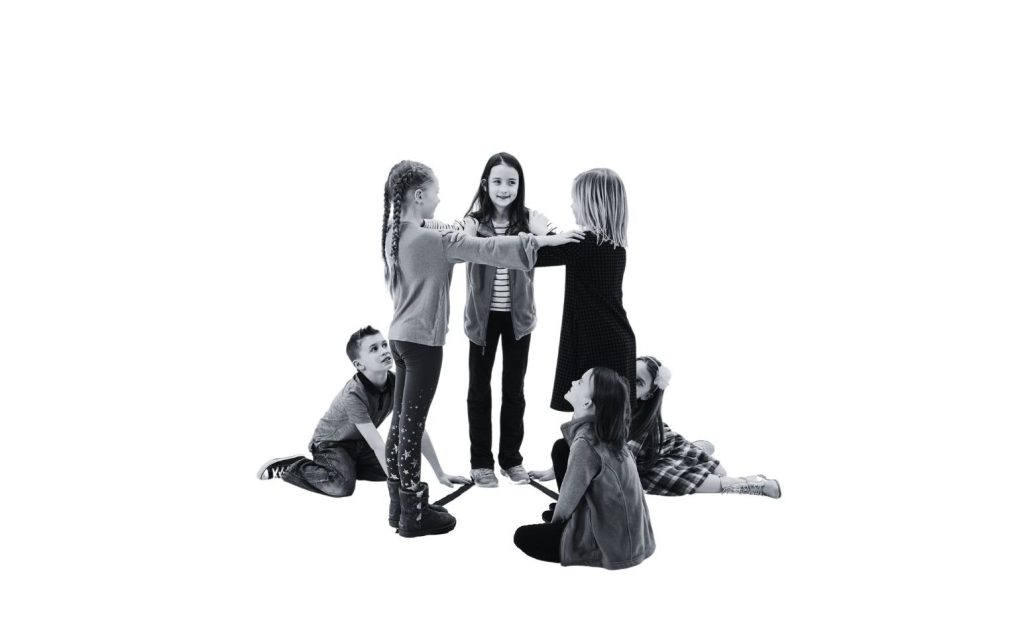
Welcome to a dynamic exploration of geometry where abstract polyhedrons become tangible through creative movement. In this lesson, students step beyond the textbook and use their bodies to construct and experience the building blocks of three-dimensional shapes—faces, edges, and vertices. They will dive into an immersive activity that transforms theoretical concepts into physical reality, sparking curiosity and collaboration. By engaging in this interactive process, learners begin to see geometry not just as a series of static forms, but as a vibrant, interconnected art that exists all around them.
Lesson Title: Building Shapes
Grade Level: Grades 3–5
Duration: 3 Class Periods (30 minutes each)
Standards:
Math Standards
Geometry
- Identify and describe the properties of common 3-D shapes (cube, pyramid, cone, cylinder) by counting faces, edges, and vertices.
- Analyze and compare different 3-D objects to explore how their properties define their structure.
- Apply spatial reasoning and counting strategies to determine the characteristics of 3-D shapes.
Measurement & Data
- Use counting and simple measurement techniques to quantify properties of 3-D objects.
- Connect the characteristics of 3-D shapes to real-world objects and contexts.
Dance Standards
Creating
- Explore and experiment with movement patterns that represent the structure of 3-D shapes.
- Use body positioning to mimic edges, vertices, and faces, reinforcing an understanding of spatial properties.
Performing
- Demonstrate kinesthetic awareness and safe movement as students physically form and transform 3-D shapes.
- Adjust body formations to accurately represent different geometric properties.
Responding & Connecting
- Describe how movement can reflect the structure and symmetry of 3-D objects.
- Connect dance movements with real-world applications, highlighting spatial relationships and geometric properties.
Essential Questions
- How can we use our bodies to understand the properties of 3-D objects?
- What are the key features that define common 3-D shapes such as cubes, pyramids, cones, and cylinders?
- In what ways does movement help us visualize and explain geometric properties like faces, edges, and vertices?
Learning Objectives
- Students will identify and describe the properties of 3-D objects by counting their faces, edges, and vertices.
- Students will construct and manipulate 3-D shapes using body movements to represent edges, vertices, and faces.
- Students will develop spatial awareness and kinesthetic understanding through collaborative shape-building activities.
- Students will articulate the differences between various 3-D shapes using proper geometric vocabulary.
Success Criteria
Identifying 3-D Properties
- I can accurately count and describe the faces, edges, and vertices of standard 3-D shapes.
- I can explain how these properties distinguish one shape from another.
Exploration Through Movement
- I can use my body to form parts of a 3-D object (using stretched arms for edges and positions for vertices).
- I adapt my movements to represent different geometric properties effectively.
Collaboration and Explanation
- I work well with peers to construct and analyze shapes.
- I can clearly explain the properties of a 3-D shape using appropriate geometric language.
Materials
- Large foam or cardboard shapes representing 3-D objects (cube, pyramid, cone, cylinder)
- String or ribbons to mark edges on the floor
- Masking tape to indicate vertices
- Paper cutouts of 3-D shapes (for seated alternatives)
- Solid colored poles or pool noodles to create visual lines.
- Worksheets for recording properties
Lesson Activities:
Activity One: Introduction & Review
- Introduce common 3-D shapes (cube, pyramid, cone, cylinder) using visuals and tactile models.
- Describe their properties: faces, edges, and vertices—demonstrating with a foam cube by counting aloud.
Activity Two: Movement Construction

- In small groups, students use their bodies to form the shape’s structure (e.g., stretching arms to form edges, positioning bodies as vertices).
- Use string, poles, or ribbons to simulate edges and masking tape to mark vertices on the floor.
- As a group, count the faces, edges, and vertices together and discuss the differences between shapes.
- Repeat the process with other 3-D shapes, encouraging students to adapt their movements based on the number of edges or vertices.
Activity Three: Hands-On and Real-World Exploration

- For limited space or alternative participation, students work at their desks with paper cutouts to form shapes.
- Have students draw and label the faces, edges, and vertices of each shape.
- Extend the learning by discussing real-world examples (e.g., dice, pyramids) and, optionally, exploring concepts like volume or surface area.
Activity Four: Deepening Understanding with the Worksheets
Assignment: Using your pencil, draw a line between the shape and the dancers correctly performing the shape.


There are other types of solid figures, such as cylinders, spheres, and cones that have curved faces and no straight edges. Though a cone has no straight edges, it does have a single vertex.
Assignment: Work with a partner to create turning shapes and decide together if the shape is a cylinder, cone, or sphere.
Adaptations and Modifications:
Learner Needs Addressed
• Designed for students with visual or hearing impairments and those with fine motor difficulties.
Adapted Materials/Tools
• Use tactile 3-D models for students with visual impairments.
• Provide clear visual aids, written instructions, and simple diagrams for students with hearing impairments.
• Offer alternative materials (foam shapes, paper cutouts, or rubber bands) to facilitate understanding.
Instructional Strategies
• Break down each shape step by step with both verbal and visual cues.
• Use consistent modeling with repeated vocabulary such as “face,” “edge,” and “vertex.”
• Demonstrate tactile strategies and provide hands-on support during shape-building.
Peer Support & Grouping Ideas
• Encourage students to work in pairs, with one guiding the other through the shape-building process.
• Organize small groups based on abilities to ensure balanced support and collaboration.
Assessment
• Observe and document student participation during group activities, focusing on the accuracy of their counts and their use of geometric vocabulary.
• Have students complete a worksheet identifying and labeling the properties of various 3-D shapes.
• Use informal group discussions or exit tickets where students explain a shape’s properties.
Build a Shape transforms the abstract properties of 3-D objects into an interactive, hands-on experience. By constructing and manipulating shapes through body movement, students gain a deeper, tangible understanding of faces, edges, and vertices. This lesson not only reinforces geometric vocabulary and spatial reasoning but also promotes creativity, collaboration, and kinesthetic learning. Through active exploration, students discover that geometry is alive in the world around them—both in physical objects and in the expressive movements of dance.

Leave a comment