
The Invisible Framework of Effective Teaching Artists
Teaching artists bring a distinct kind of power into educational spaces. Through music, movement, visual art, writing, and performance, they help students make sense of their inner lives and their place in the world. The arts offer comfort, invite empathy, and provide a creative outlet for processing complex emotions. They encourage mindfulness, support cognitive development, and can reduce stress, anxiety, and depression. When teaching artists enter a classroom, they are not simply delivering content. They are shaping human experience.
This responsibility requires more than artistic skill. It requires self-regulation. Guest teaching artists step into classrooms filled with variables they cannot control. Schedules shift. Time is shortened by assemblies or testing. Students arrive carrying emotional weight that may be invisible. A non-verbal student may need focused support while others are trying to follow the lesson. In these moments, the teaching artist must respond thoughtfully, often without the benefit of background knowledge or long-term relationships.
Self-regulation is the ability to manage one’s emotions, attention, and behavior as a catalyst for a positive outcome. It is the reason professionals show up prepared, even on difficult days. It is the discipline behind pausing before reacting, choosing calm over frustration, and maintaining clarity under pressure. In the classroom, self-regulation is visible. Students observe how adults handle stress, disappointment, and disruption. The teaching artist’s response becomes a lesson in emotional intelligence.
When the body and mind are regulated, teaching artists are able to think clearly and act with intention. Self-regulation creates the internal conditions needed for good decision-making, especially in fast-moving classroom environments. Rather than relying on a single teaching method, a regulated teaching artist can adapt in real time, responding to students, space, and circumstance with purpose and clarity.
Learning theories are simply ways to explain how people learn. They help teachers understand what helps students pay attention, remember information, and use what they have learned. No one learns the same way all the time, so teachers often use more than one theory depending on the situation.
- Behaviorism focuses on what you can see. Learning happens when behavior changes because of rewards or consequences. For example, getting praise, grades, or extra credit can encourage certain behaviors. This approach works well for practice, routines, and clear expectations.
- Cognitivism looks inside the brain. It focuses on memory, attention, and thinking. Learning happens when new information connects to what you already know. Study strategies, note-taking, chunking information, and step-by-step explanations come from this theory.
- Constructivism says learners build understanding through experience. Instead of being told everything, students explore, ask questions, and solve problems. Group projects, labs, and discussions help students make meaning for themselves.
- Social Learning Theory explains that people learn by watching others. You might pick up skills by observing a teacher, classmate, or video. Modeling, imitation, and motivation all play a role.
- Humanism focuses on the whole person. It values choice, personal goals, and emotional safety. When students feel respected and supported, they are more motivated to learn.
- Connectivism reflects learning today. Knowledge is shared through technology, networks, and relationships. Knowing where to find information is just as important as memorizing it.
Understanding these theories helps explain why teachers use different strategies and why certain approaches work better in different situations.
Teaching artists often move fluidly among these approaches within a single session. That flexibility depends on self-regulation. When calm and grounded, the artist can assess what students need and select strategies that best support learning. When overwhelmed, even well-practiced methods become harder to access. Self-regulation, then, is not separate from pedagogy. It is the foundation that makes responsive, theory-informed teaching possible.
By the time many teaching artists enter schools, they already possess a strong foundation of self-regulation. Their work then becomes an act of generosity. They slow the room down. They acknowledge stress without judgment. They create breathing space for students and often for educators who are tired and stretched thin. Through their presence, they model how to remain steady in uncertain conditions.
This is the quiet framework behind effective teaching artistry. Self-regulation paired with a broad understanding of learning theory creates classrooms where creativity thrives, challenges are met with clarity, and learning feels both structured and humane.
Ready to bring consistency, trust, and impact to your work?
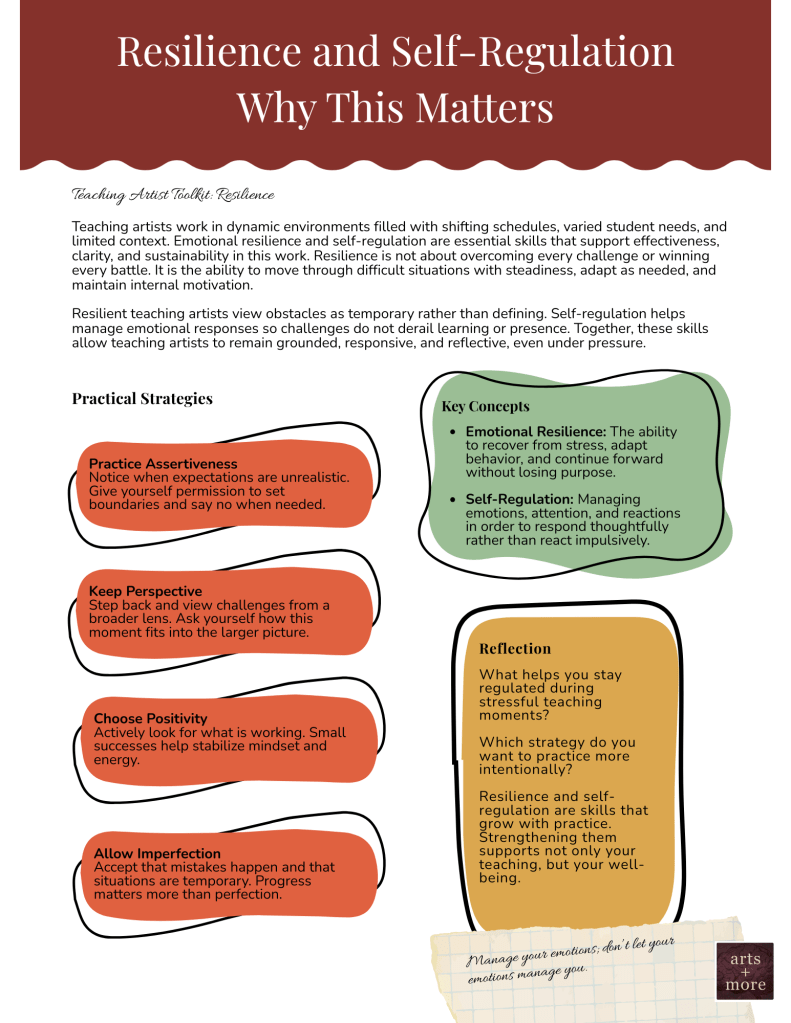
I invite you to download the Resilience and Self-Regulation Worksheet from the Teaching Artist Toolkit for practical tips to clarify your goals, identify barriers, and create an action plan for forward movement…
…WHICH MEANS you’ll start showing up with intention for your students and your creative projects today.
If you’ve found value in this work, I would love to hear from you. A short testimonial, Google review, or comment helps me improve and allows others to see the difference we’re striving to make together.


Leave a comment