
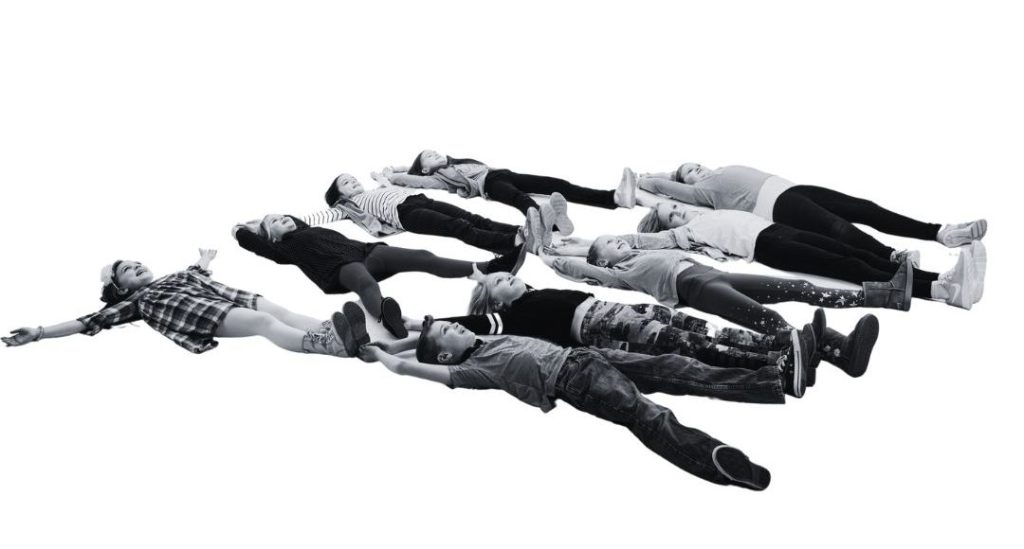
In this lesson, students will explore the concept of tessellations—patterns made by repeating shapes without any gaps or overlaps. By using their bodies to form living tessellations, students will gain a physical understanding of how shapes can fit together in a continuous pattern. Through music, movement, and visual examples, this lesson connects geometry to dance, helping students recognize patterns and spatial relationships in both math and the world around them.
Lesson Title: Tessellation Train
Grade Level: 2nd–5th Grade
Duration: 3 Class Periods (30 minutes each)
Standards
Math Standards
Geometry
- Recognize and describe repeating patterns and how shapes fit together to cover a surface without gaps or overlaps (tessellations).
- Understand and use spatial relationships to describe shape placement and orientation.
Mathematical Practices
- Use appropriate tools strategically.
- Look for and make use of structure.
- Attend to precision in repeated patterns.
Dance Standards
Creating
- Explore and experiment with movement patterns that reflect visual designs and repetition.
- Use choreographic devices such as repetition and spatial design to create pattern-based movement.
Performing
- Demonstrate safe and coordinated movement when performing in group formations.
- Maintain rhythmic accuracy and spatial awareness while executing structured sequences.
Responding
- Reflect on and analyze how repeated movement patterns create artistic and geometric structure.
Connecting
- Recognize relationships between movement and patterns in math and the world around us.
- Explore how dance can express and embody geometric concepts like tessellations.
Essential Questions
- What is a tessellation and what rules does it follow?
- How can we use our bodies to create a pattern that repeats without gaps or overlaps?
- How does movement help us understand patterns and shape relationships?
Learning Objectives
- Students will define and describe the characteristics of tessellations.
- Students will explore how repeating shapes fit together using movement and body positioning.
- Students will collaborate to form a human tessellation using assigned body shapes.
- Students will apply knowledge of spatial relationships and patterns in both physical and visual formats.
Success Criteria
Understanding Patterns
- I can explain what a tessellation is.
- I can identify shapes that tessellate and describe why they work.
Movement and Collaboration
- I can create a shape with my body and repeat it next to others without leaving gaps or overlaps.
- I can work with my classmates to form a living tessellation.
Visual Application
- I can draw and describe the shape pattern I created with my group.
- I can recognize tessellations in the world around me.
Materials
- Shape cutouts (triangles, squares, hexagons)
- Masking tape or floor markers
- Music player
- Optional: tessellation worksheets or art supplies for extension activities
Lesson Activities
Activity One: Introduction
- Share what a tessellation is by using visuals (e.g., honeycombs, tile floors, M.C. Escher art) to introduce the concept.
- Discuss the rules of tessellation: shapes must fit together without gaps or overlaps.
Activity Two: Shape Posing Practice
- Assign each student a shape (triangle, square, or hexagon).
- Guide them in creating that shape with their bodies using arms, legs, or full-body positions.
- Practice freezing and holding the shape accurately while standing or laying next to their neighbor.

Activity Three: Tessellation Train
- Play music as students walk around the space.
- When the music stops, students “lock in” next to one another by repeating their assigned shape to form a human tessellation.
- Pause to observe — does the pattern repeat? Are there any gaps or overlaps?
- Have students shift or adjust to improve accuracy.
Activity Four: Draw & Reflect

After movement, students draw what their living tessellation looked like using pencil and worksheet.
Label their shapes and describe how they fit together.
Optionally, extend the activity into a tessellation art project.
Modifications for Space / Equipment:
- Use tabletop paper cutouts, Velcro boards, or interactive digital programs for limited mobility or confined classrooms.
Integration Tips:
- Pair this lesson with an art project using colored shape stamps or tiles to create printed tessellation designs.
- Extend into math by identifying the number of sides and angles of each tessellated shape.
Adaptations:
Learner Needs Addressed:
Students with mobility limitations, visual processing challenges, or sensory sensitivities.
Adapted Materials / Tools:
- Use puzzle piece manipulatives or pre-cut paper shapes.
- Tactile materials like felt or Velcro can help students physically arrange repeating shapes.
- Shape outlines on paper or tables for seated students.
Instructional Strategy:
- Focus on one shape at a time.
- Provide clear step-by-step demonstrations.
- Use music cues to support timing and transitions.
Peer Support / Grouping Ideas:
- Partner students into “tessellation teams” to assist each other in forming the patterns.
- Assign shape leaders to guide group formations.
Assessment Notes:
- Observe how students use their bodies to form shapes and whether they understand the concept of repetition without gaps.
- Use the worksheet to assess pattern recognition and shape matching.
- Ask reflection questions:
- “What made our human tessellation work?”
- “How did you know your shape fit with others?”
The Tessellation Train lesson offers students a fun and engaging way to explore geometry through movement. By using their bodies to create repeating shape patterns without gaps or overlaps, students gain a deeper understanding of tessellations and spatial relationships. This hands-on, collaborative experience supports both mathematical reasoning and creative expression, helping learners internalize geometric concepts through kinesthetic activity. Whether dancing into place or reflecting through art and discussion, students connect math to real-life patterns and strengthen their ability to recognize structure, rhythm, and precision in the world around them.

Leave a comment