
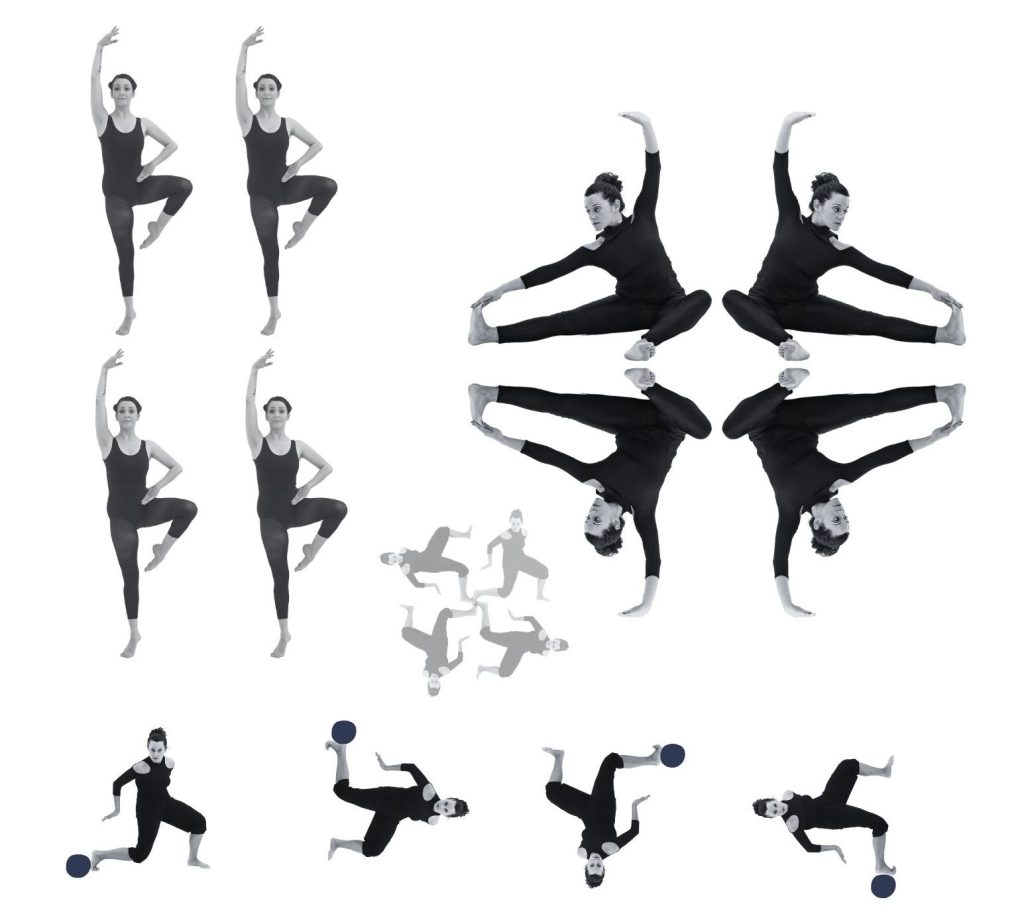
In this interactive lesson, students bring geometry to life by exploring how shapes move and change through rotation, translation (sliding), reflection (flipping), and resizing (scaling). Using their bodies and visual prompts, students will physically experience the key concepts of transformation. This kinesthetic approach strengthens spatial reasoning, reinforces vocabulary, and supports multiple learning styles by connecting movement with geometry in a creative, memorable way.
Lesson: Shape Shifter Stations
Grade Level: 3rd–5th Grade
Duration: 1–2 Class Periods (30 minutes each)
Standards
Math Standards – Geometry
- Identify and describe transformations of shapes including rotations (turns), reflections (flips), translations (slides), and dilations (scaling).
- Understand that shapes in different orientations are still the same shape and maintain defining attributes.
- Use visualization, spatial reasoning, and geometric modeling to solve problems.
Dance Standards
Creating
- Explore movement vocabulary that shows contrast in direction, level, and size.
- Use improvisation to transform a shape in space through time and energy changes.
Performing
- Demonstrate body control and spatial awareness during movement transformations.
- Perform movement phrases with attention to directionality and focus.
Responding
- Describe how movements change in direction, space, and size.
- Reflect on how movement choices represent abstract concepts like rotation or scale.
Connecting
- Make connections between shape transformations in math and choreographic movement.
- Recognize how body shapes relate to geometric ideas through space and direction.
Essential Questions
- How do shapes change when we rotate, flip, slide, or stretch them?
- How can our bodies help us understand transformations in geometry?
- What role does direction and space play in how we move and perceive shapes?
Learning Objectives
- Students will demonstrate four basic geometric transformations using movement.
- Students will identify and describe transformations including rotation, translation, reflection, and resizing.
- Students will connect physical movement to visual shape changes.
- Students will reflect on movement choices and their mathematical meanings.
Success Criteria
Geometric Understanding
- I can correctly demonstrate rotation, translation, reflection, and resizing using my body.
- I can explain how each transformation changes the position or size of a shape.
Kinesthetic Representation
- I can use my body to show how shapes move and change in space.
- I can connect movement actions (spin, slide, flip, stretch) to math vocabulary.
Collaboration & Communication
- I can work with a partner or group to complete shape transformation activities.
- I can describe and reflect on shape transformations using visual and movement-based examples.
Visual Reasoning
- I can draw or trace shapes before and after transformations.
- I can recognize and label transformation types when I see them in pictures or movement.
Lesson Activities
Activity One: Introduction
- Begin by introducing the four types of shape transformations: rotation, translation (slide), reflection (flip), and resizing (scale/stretch).
- Use simple visuals or body movements to demonstrate each concept.
- Discuss how dancers and shapes can move similarly through space.
Activity Two: Shape Shifter Stations
- Set up 4 physical stations around the room, each focusing on one transformation:
- Rotate Station: Students spin in place to show rotation.
- Slide Station: Students glide side-to-side or forward-backward across the floor to show translation.
- Flip Station: Students turn to face the opposite direction to show reflection.
- Stretch Station: Students widen or narrow their stance or arm span to show resizing.
- At each station, students will use their arms or whole body to demonstrate the assigned transformation with a basic shape (triangle, square, etc.).
Activity Three: Group Practice and Discussion
- After visiting all stations, students gather in small groups to discuss which transformations felt easy or tricky.
- Groups act out a short sequence using multiple transformations.
- Classmates observe and try to identify which transformations were shown.
Activity Four: Draw and Reflect

- Students return to their seats and complete the worksheet .
- They trace a shape then complete each transformation.
- Encourage students to identify the vertices in each figure.
Adaptations and Modifications
Learner Needs Addressed
- Students with restricted movement
- Students with difficulty processing directionality
Adapted Materials
- Shape cutouts with arrows showing each transformation
- Felt boards or tracing overlays for hands-on support
- Paper arrows or manipulatives for tabletop demonstrations when physical movement is limited
Instructional Strategies
- Use consistent, verbal movement cues (e.g., “flip = turn over,” “slide = move straight across”)
- Break down each transformation step-by-step before stations
- Model each movement slowly with repetition and visual supports
Peer Support & Grouping Ideas
- Work in trios: one student demonstrates, one describes, one draws the transformation
- Rotate roles to allow all learners to engage through their strengths
- Pair students with differing abilities for supportive peer modeling
Modifications for Space & Equipment
- Replace full-body movement with tabletop paper arrows and manipulatives
- Use drawings or shape models to simulate transformations when space is limited
- Stations can be done at desks with traceable shapes and dry-erase markers
Suggested Grade Levels / Abilities
- Grades 3–5
- Strong support for visual and kinesthetic learners, adaptable for a range of mobility levels
Integration Tips
- Extend the activity by having students create digital drawings or stop-motion videos of shape transformations
- Connect with art or media classes to explore transformations through animation
Assessment
- Provide students with images of shapes and ask them to label or trace how the shape has changed
- Observe how students demonstrate transformations physically or with manipulatives
- Listen for accurate use of transformation vocabulary during group activities and reflections
Through active exploration at each Shape Shifter Station, students deepen their understanding of how geometric figures transform in space. Whether spinning to represent a rotation, sliding across the floor, flipping directions, or stretching to show scale, students experience the abstract concepts of geometry through concrete, embodied learning. The lesson concludes with a reflection activity that helps students translate physical movement into visual representation, reinforcing both academic vocabulary and conceptual understanding in a fun, meaningful context.


Leave a comment