
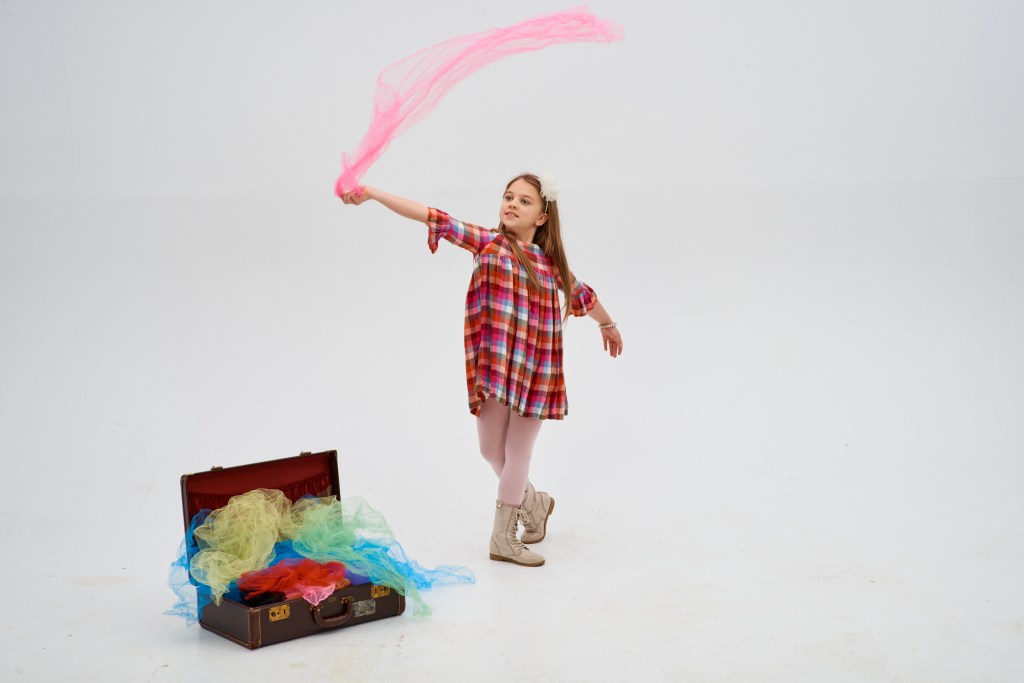
A Bonus Article for Educators
In recent years, dance science and neuroscience have begun to converge in powerful ways. What many teaching artists and creative educators have felt intuitively for decades is now being backed by exciting research: movement is not an add-on—it’s a core learning modality with measurable impact on focus, memory, emotional regulation, and community connection.
Tonight, I’m sharing a deep dive into the most current research and what I found that was energizing and deeply validating. Much of the work my colleagues and I have practiced for years is now being illuminated by brain imaging, developmental research, and motor-learning science. It’s time more educators knew just how transformative movement can be.
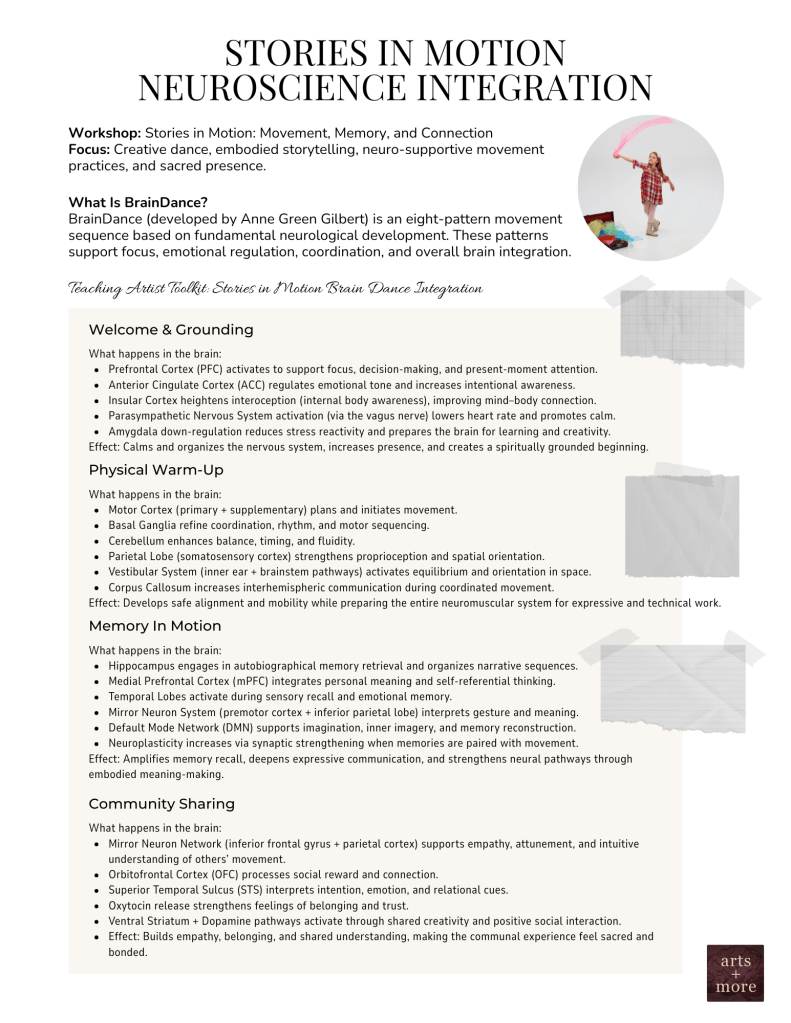
Below is an overview of what happens in the brain during different phases of the Stories in Motion workshop. My hope is that this gives you fresh insight and the confidence to weave more embodied learning into your classroom.
1. Physical Warm-Up: Preparing the Learning Brain
When the body begins to move rhythmically and intentionally, several major neural systems switch online:
- Motor Cortex initiates and organizes voluntary movement.
- Basal Ganglia refine coordination, rhythm, and automatic motor sequencing.
- Cerebellum calibrates balance, timing, and smooth execution.
- Somatosensory Cortex sharpens proprioception—students grow more aware of where they are in space.
- Vestibular System boosts orientation, equilibrium, and alertness.
- Corpus Callosum increases cross-hemisphere communication during coordinated movement.
Why it matters for learning:
Students become physically aligned, mentally alert, and neurologically primed. Movement activates the systems responsible for focus, readiness, motor planning, and emotional regulation (setting the entire classroom up for clearer thinking and deeper engagement).
2. Welcome & Grounding: Regulating the Nervous System
This short, intentional moment at the start of class is more than a ritual; it is a neurological doorway into calm attention.
What activates here:
- Prefrontal Cortex (PFC) supports focus and executive function.
- Anterior Cingulate Cortex (ACC) manages emotional tone and mindfulness.
- Insular Cortex enhances internal body awareness.
- Parasympathetic Nervous System engages via vagal pathways, reducing heart rate and stress.
- Amygdala down-regulates, lowering reactivity.
Why teachers should care:
A grounded beginning settles the nervous system, increases attention, and prepares students to participate with clarity rather than anxiety. A calm brain learns faster and remembers more.
3. Memory in Motion: Turning Story Into Lasting Learning
Linking movement with personal storytelling ignites some of the brain’s most powerful memory and meaning-making networks:
- Hippocampus retrieves autobiographical memory and organizes narrative sequences.
- Medial Prefrontal Cortex supports personal meaning and identity-based learning.
- Temporal Lobes process emotional memory and sensory detail.
- Mirror Neuron System interprets gesture, intention, and embodied narrative.
- Default Mode Network (DMN) activates imagination and internal imagery.
- Neuroplasticity increases when memory is paired with embodied action.
Why this changes everything:
When students use their bodies to express and reconstruct memory, they create stronger synaptic connections. Learning becomes personal, expressive, and neurologically sticky.
4. Community Sharing: Building Empathy and Collective Presence
When students witness and respond to each other’s movement, the social brain lights up:
- Mirror Neuron Network drives empathy and intuitive understanding.
- Orbitofrontal Cortex processes social reward and connection.
- Superior Temporal Sulcus (STS) interprets relational cues.
- Oxytocin release deepens trust and belonging.
- Dopamine pathways activate through shared creativity.
Why this transforms classroom culture:
Students feel seen. They collaborate more willingly. Creative risks become safer. When classrooms foster belonging, academic learning accelerates.
Why Teachers Should Integrate More Movement
Movement isn’t just “fun.” It’s not a break from learning.
It is a form of learning.
A powerful one.
Neuroscience now shows what many dancers and teaching artists have long known:
- Movement strengthens memory.
- Movement regulates emotion.
- Movement deepens focus.
- Movement awakens creativity.
- Movement builds community.
- Movement makes learning more equitable and accessible.
In a world where students are overwhelmed, overstimulated, and often disconnected from their bodies, movement is a path back to presence.
If you’re an educator ready to bring more embodied learning into your classroom, consider this an invitation. You don’t need a dance studio or perfect choreography. You simply need openness, curiosity, and a willingness to let movement become part of your teaching toolkit.
Your students’ brains (and hearts) will thank you.
Ready to bring consistency, trust, and impact to your work?
I invite you to download the Stories in Motion Neuroscience Integration Page from the Teaching Artist Toolkit for practical tips to clarify your goals, identify barriers, and create an action plan for forward movement…
…WHICH MEANS you’ll start showing up with intention for your students and your creative projects today.
Upcoming Event Details
Workshop: Stories in Motion: Movement, Memory, and Connection
Instructor: Kimberly Crislip Jarvis
Series: The Sacred Place – Ordered Steps Dance Company Movement Workshop Series
Date: Saturday, December 6
Time: 10:00 a.m.
Location: One Center for Leadership, 901 Tuscarawas St E. in Canton, OH.
Who Can Attend: Ages 12+ and all mobility levels are welcome. No dance experience required.
If you’ve found value in this work, I would love to hear from you. A short testimonial, Google review, or comment helps me improve and allows others to see the difference we’re striving to make together.

Dance Neuroscience & Motor Learning
Bradley, K., & Gilbert, A. G. (2006). Brain-compatible dance education. National Dance Association.
Gallese, V. (2007). The “shared manifold” hypothesis: Embodied simulation and its role in empathy. Psychopathology, 40(3), 163–170.
Houston, S., & McGill, A. (2013). A mixed-methods study into ballet for people living with Parkinson’s. Arts & Health, 5(2), 103–119.
Krakauer, J. W., & Shadmehr, R. (2006). Consolidation of motor memory. Trends in Neurosciences, 29(1), 58–64.
LaMothe, K. (2015). Why we dance: A philosophy of bodily becoming. Columbia University Press.
Lovatt, P. (2018). The dance cure: The surprising science to being smarter, stronger, happier. HarperCollins.
Wolpert, D. M., Diedrichsen, J., & Flanagan, J. R. (2011). Principles of sensorimotor learning. Nature Reviews Neuroscience, 12, 739–751.
Embodied Cognition, Emotion, and Learning
Damasio, A. R. (1999). The feeling of what happens: Body and emotion in the making of consciousness. Harcourt Brace.
Gallagher, S. (2005). How the body shapes the mind. Oxford University Press.
Immordino-Yang, M. H. (2016). Emotions, learning, and the brain: Exploring the educational implications of affective neuroscience. W. W. Norton.
Singer, T. (2009). Understanding others: Brain mechanisms of empathy and social cognition. In P. W. Glimcher, C. Camerer, E. Fehr, & R. A. Poldrack (Eds.), Neuroeconomics: Decision making and the brain (pp. 251–268). Academic Press.
van der Kolk, B. A. (2014). The body keeps the score: Brain, mind, and body in the healing of trauma. Viking.
Movement, Memory, and Sensory Integration
Chatterjee, A., & Vartanian, O. (2014). Neuroaesthetics. Trends in Cognitive Sciences, 18(7), 370–375.
Hannaford, C. (2005). Smart moves: Why learning is not all in your head (2nd ed.). Great River Books.
Education-Focused Brain & Movement Research
Jensen, E. (2005). Teaching with the brain in mind (2nd ed.). Association for Supervision and Curriculum Development.
BrainDance Reference
Gilbert, A. G. (2006). BrainDance. Creative Dance Center.

Leave a comment