
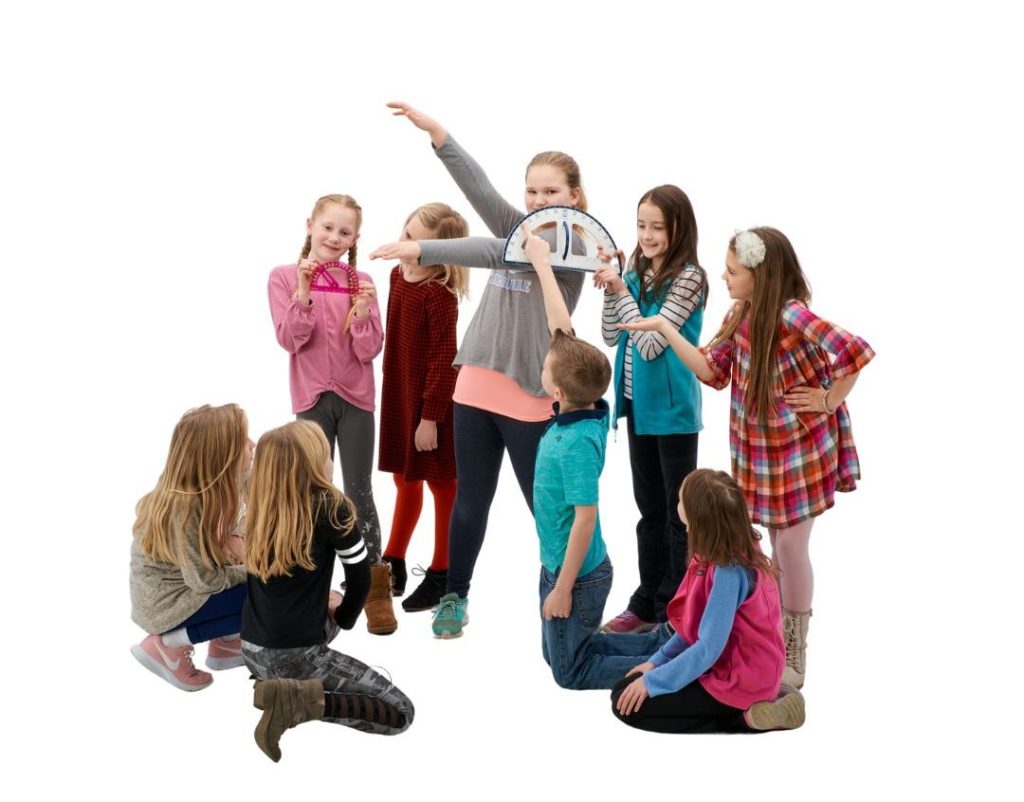
Students will learn how to use a protractor to measure and draw angles and identify types of angles based on their measurements.
Lesson Title: Using a Tool for Measuring and Drawing Angles
Grade Level: Grades 2–4
Duration: 2–3 Class Periods (30–40 minutes each)
Standards:
- Math Standards: Measure angles in whole-number degrees using a protractor; sketch angles of specified measure; classify angles as acute, right, or obtuse.
- Dance Standards:
- Students can identify and demonstrate common elements (such as space, time, and energy) and how they contribute to artistic expression.
- Students can safely and appropriately prepare their minds and bodies for dancing.
- Students explore how shape and body alignment contribute to performance and communication.
Essential Questions:
- How can a protractor help us understand and create different types of angles?
- What do angles look like in the world around us and in the way we move?
- How do measurement and movement help us explore geometry creatively?
Learning Objectives:
- Students will use a protractor to measure angles accurately.
- Students will draw and label acute, right, and obtuse angles.
- Students will identify angles in objects and replicate them with their bodies.
- Students will collaborate and use tools to explore angles through hands-on practice and creative movement.
Success Criteria:
- I can use a protractor to measure an angle in degrees.
- I can draw and label three types of angles: acute, right, and obtuse.
- I can find angles in objects around me and describe or model them.
- I can explain how to use a protractor and identify angle types confidently.
Materials:
Protractors, pencils, rulers, angle worksheets, laminated shape cards or posters (optional), classroom objects for exploration
Lesson Activities
Introduction: Introduce the concept of angles and explain how to use a protractor. Demonstrate the three types of angles: right (90°), acute (<90°), and obtuse (>90°).
Activity One: Angle Measuring Practice

Demonstrate how to measure angles with a protractor:
- Place the midpoint on the vertex
- Align one side with the baseline
- Read the angle measurement from the correct scale
Students practice measuring angles on pre-drawn angle worksheets.
Encourage partner checks for accuracy and support.
Activity Two: Draw Your Own Angles
Use a ruler and protractor to draw:
- One acute angle
- One right angle
- One obtuse angle
Label each with its measurement in degrees and type of angle.
Activity Three: Angle Matching
Using laminated shape cards or classroom objects:
- Identify angles in everyday items.
- Use your protractor to measure and classify them.
- Create body shapes to match the shape of the everyday item.
- Record your answers on your worksheet.
Modifications for Space / Equipment:
Use laminated table-sized shape cards for seated or small-space activities. These allow students to measure angles without standing or walking.
Suggested Grade Levels / Abilities:
Grades 2–4; highly flexible for diverse settings and easy to scale with vocabulary support.
Integration Tips:
Pair this activity with a shape identification worksheet or a drawing task that reinforces vocabulary and classification of angles in 2D shapes.
Adaptations
Learner Needs Addressed:
Students with visual impairments, motor delays, or sensory sensitivities.
Adapted Materials / Tools:
- Use textured or raised-line shapes for tactile identification.
- Offer shape wands or pointers for students who cannot trace angles.
- Provide high-contrast visuals or large print protractors.
Instructional Strategy:
Use guided instructions with fewer transitions and consistent repetition. Reinforce terms like “sides,” “corners,” “open,” and “wide” during practice.
Peer Support / Grouping Ideas:
Assign roles such as shape tracer, describer, and measurer in group work. Encourage peer modeling and verbal reasoning.
Assessment Notes:
- Offer guided practice to assess individual understanding before independent work.
- Observe students as they measure and draw angles using a protractor.
- Listen for correct use of angle vocabulary (acute, right, obtuse).
- Check for proper tool use, including protractor alignment and degree reading.
- Have students identify and classify angles in everyday objects.
- Use verbal prompts, visual cues, or pointing for students who need alternative response methods.
- Include peer explanation or partner checks as informal assessment opportunities.
By learning to measure and draw angles using a protractor, students develop both mathematical precision and spatial awareness. Blending analytical thinking with creativity, this lesson encourages learners to see geometry not just on paper, but also in the movement of their own bodies and the shapes around them. These foundational skills strengthen both math fluency and expressive thinking—essential tools in both academic and artistic settings. By integrating dance and geometry, students gain a deeper, embodied understanding of angles that supports long-term retention and joyful learning.



Leave a comment