

The start of the school year is the perfect time to set the stage—literally and figuratively—for curiosity, collaboration, and creativity. That’s why I’m excited to share this lesson plan with you. It blends math and movement in a way that engages students from the very beginning, helping them build both confidence and community in the classroom.
In this lesson, students learn key vocabulary related to the coordinate plane and stage directions. But instead of just memorizing terms, they’ll embody the concepts by moving across a large-scale coordinate grid. Using their whole bodies, students will locate and plot ordered pairs, connect mathematical coordinates with theatrical stage directions, and interpret pathways that challenge them to think spatially.
It’s a dynamic introduction to the year that brings abstract ideas to life. By combining movement, math, and the arts, this activity strengthens comprehension while keeping energy high. Students leave the lesson with a stronger grasp of coordinate systems, a shared classroom experience, and the sense that learning can be both rigorous and fun.
Lesson Title: Find Your Place on the Stage
Grade Level: 4th–6th Grade
Duration: 3 Class Periods (30–40 minutes each)
Standards:
Mathematics Standards:
- Understand and use ordered pairs to locate points on a coordinate plane.
- Recognize and identify the four quadrants of the coordinate system.
- Describe positions using directional language and grid-based references.
Dance Standards:
- Use movement to explore spatial pathways and directions in personal and general space.
- Demonstrate understanding of spatial relationships through stage direction and body placement.
- Collaborate in small groups to explore movement across planes and pathways.
Essential Questions:
- How can we use a coordinate grid to describe and locate positions in space?
- How does understanding stage directions help dancers and performers move with clarity and purpose?
Learning Objectives:
- Students will define and use vocabulary related to coordinate planes and stage directions.
- Students will locate and plot ordered pairs on a large-scale coordinate grid using full-body movement.
- Students will connect mathematical coordinates with theatrical stage directions.
- Students will interpret and recreate movement pathways using coordinate pairs and spatial cues.
Success Criteria:
Coordinate Plane Understanding:
- I can identify and label the X- and Y-axes and the four quadrants.
- I can locate and stand on a point that matches an ordered pair.
Stage Direction Integration:
- I can identify upstage, downstage, stage left, stage right, and center stage.
- I can connect stage directions with parts of the coordinate plane.
Movement and Collaboration:
- I can follow a coordinate pathway and perform it with accuracy and confidence.
- I can support a partner in navigating or presenting a movement sequence on a grid.
Materials:
- Floor tape or chalk
- Index cards with coordinate pairs
- Cones or markers for quadrant labeling
- Worksheets for coordinate and pathway drawing
- Music (optional for movement transitions)
- Large open space (gym or stage preferred)
Lesson Content
X-Axis: The horizontal number line on a coordinate plane.
Y-Axis: The vertical number line on a coordinate plane.
Coordinate Plane: A two-dimensional space formed by the intersection of the X- and Y-axes.
Coordinate Pair (Ordered Pair): A set of two numbers (x, y) used to locate a point on the coordinate plane.
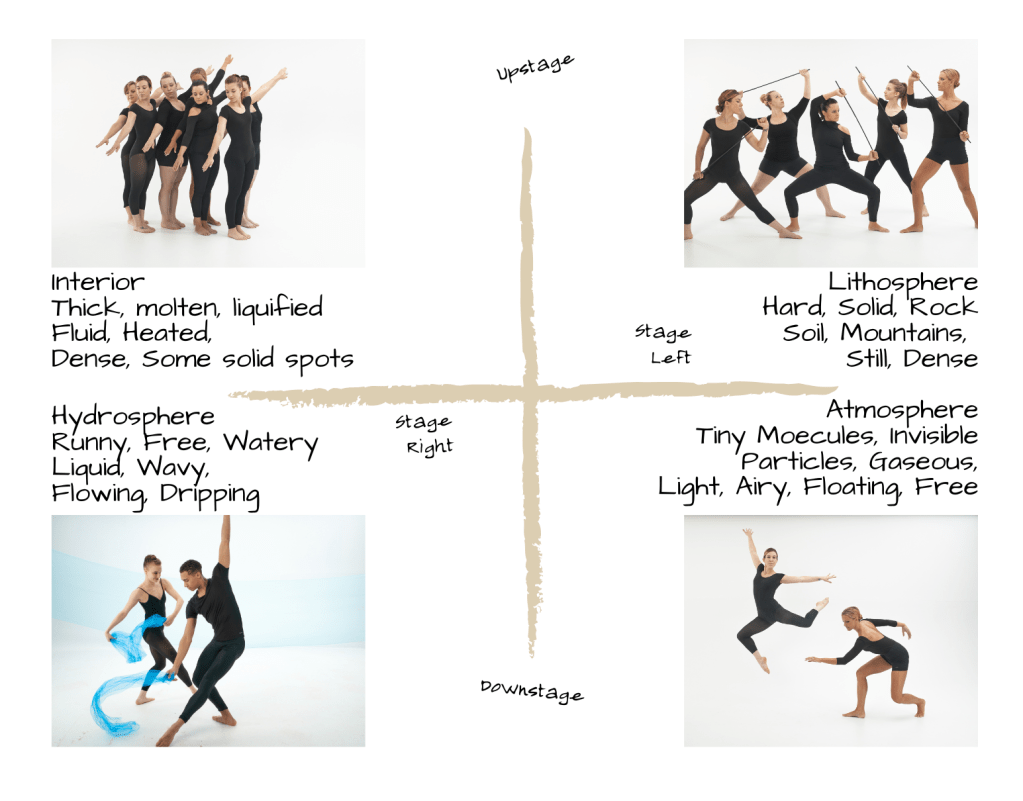
Upstage: The area of the stage farthest from the audience.
Downstage: The area of the stage closest to the audience.
Stage Right: The right side of the stage from the actor’s perspective facing the audience.
Stage Left: The left side of the stage from the actor’s perspective facing the audience.
Center Stage: The middle point of the stage, equidistant from all sides.
Transverse Plane: A horizontal plane that divides the body or space into upper and lower parts (also called the bird’s-eye view).

Introduction
Activity One: Coordinate Plan Worksheet

- View the picture of the coordinate plane and circle the math terms plane.
- View the picture of the coordinate plane and put a square around the stage terms.
- Using a pencil, please label the grid at the bottom of the page.
Activity Two: Human Graphing Grid

- Visit the theater stage and identify stage directions.
- Tape out a giant X and Y axis on the floor. Label the four quadrants.
- Give students coordinate cards (e.g., (2, -3)).
- One by one, students walk to and “stand on” their coordinate.
- The class checks accuracy. Repeat as a relay or team game.
- Use a ball or object to “toss” to new coordinates, calling out directions as review.

Activity Three: Scribble Journey

- Partner students.
- Have students draw or scribble a pathway with a crayon or pencil on the worksheet.
- Allow them to trade and learn the partner’s pathway.
- Take turns walking, prancing, skipping, jogging the pathways for the class to watch.
Modifications for Space / Equipment:
Use mini whiteboards with graphs if large floor space isn’t available.
Suggested Grade Levels / Abilities:
Grades 4–6; very kinesthetic-friendly.
Integration Tips:
Connect with graphing on paper afterward or challenge students to “draw” shapes with coordinates.
Adaptations
Learner Needs Addressed:
Students with motor limitations, spatial difficulties, or anxiety in front of peers.
Adapted Materials / Tools:
Provide magnetic or digital coordinate plane models. Allow pointing or using small figures on a tabletop grid.
Instructional Strategy:
Use modeling, guided practice, and clear quadrant cues. Limit the range at first (e.g., just Quadrant I).
Peer Support / Grouping Ideas:
Assign a “navigator” and a “walker” for each pair. Trade off roles to keep everyone engaged.
Assessment Notes:
Formative Observation: Monitor students as they move to assigned coordinates on the floor grid, noting their understanding of x- and y-axis placement and quadrant identification.
Verbal Check-Ins: Ask students to explain their movement choices using coordinate and stage vocabulary (e.g., “I moved to (-3, 2) which is in Quadrant II, upstage left”).
Partner Accuracy: During the Scribble Journey activity, observe how well students interpret and perform their partner’s drawn paths.
Worksheet Review: Collect and assess the coordinate plane worksheets for accuracy in labeling, matching math and stage terms, and identifying quadrants.
Exit Ticket Option: Ask students to write or verbalize how to find the location of a point, or describe the difference between stage left and Quadrant III.
This lesson combines mathematical precision with artistic expression, giving students a dynamic way to understand coordinate planes through full-body movement. By using the stage as a giant graph, learners develop spatial reasoning, directional awareness, and collaborative problem-solving—all while building fluency in both math and performance language. The embodied experience makes abstract concepts like ordered pairs and quadrants more accessible, meaningful, and memorable. This cross-disciplinary approach encourages students to see math as something they can feel, see, and move through, laying the groundwork for deeper comprehension and creative confidence.


Leave a comment