
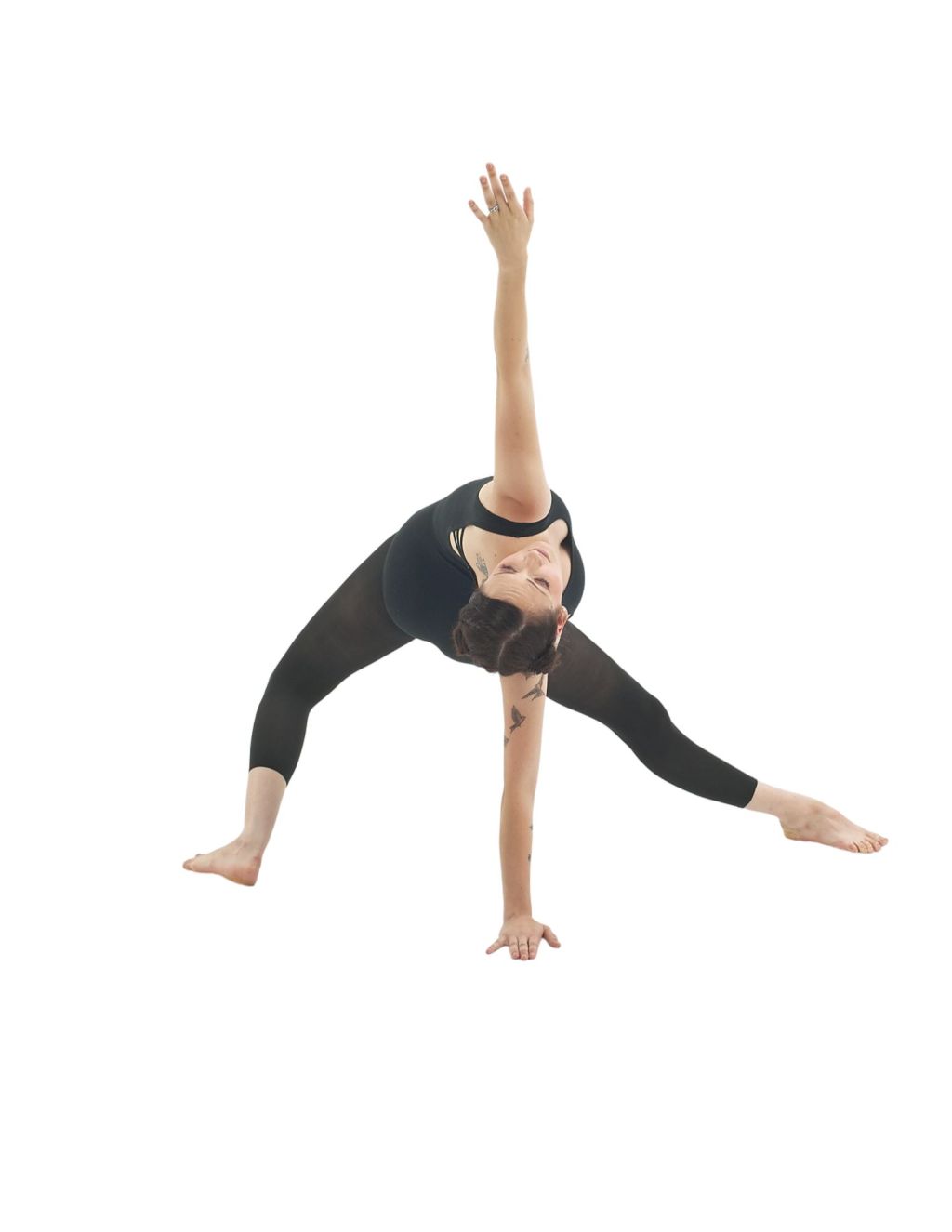
In this lesson, students will discover how dance can bring mathematics to life. By using their bodies to create triangles, angles, and other geometric forms, dancers learn to see math not just as numbers on a page but as shapes moving through space. The lines we draw with our arms, legs, and pathways help us visualize and understand important geometric principles in an active, memorable way.
Lesson Title: Making Triangles and Angles Through Dance
Grade Level: 2nd Grade
Duration: 5 Class Periods (30 minutes each)
Standards
- Math (Geometry):
- Recognize and draw shapes with specified attributes, such as a given number of angles or sides.
- Identify and describe triangles using body positions and movement patterns.
- Understand how angles are formed and classified in relation to a triangle’s properties.
- Math (Measurement & Data):
- Measure and estimate lengths in standard units (visual lines between body parts).
- Relate addition and subtraction to length (tracing and labeling triangle sides).
- Dance (Creating):
- Explore and experiment with basic locomotor and non-locomotor movement patterns using changes in time, space, body shape, and movement quality to construct and express personal meaning.
- Dance (Performing):
- Demonstrate kinesthetic awareness, self-direction, and safe practices when improvising and performing.
- Dance (Responding):
- Describe different ways movements shaped into dance depict feelings and emotions.
- Dance (Connecting):
- Observe, learn, and explore dance forms from various cultures.
- Recognize how movement patterns relate to geometric concepts like triangles and angles.
Essential Questions:
- How can dancers use movement to demonstrate mathematical concepts like triangles and angles?
- How do visual lines created through movement help us understand geometric principles?
- How does exploring dance from different cultures expand our understanding of movement and shape?
Learning Objectives:
- Students will identify and create triangle shapes using their bodies.
- Students will recognize and describe angles formed through movement.
- Students will use visual lines to trace and label parts of a triangle.
- Students will demonstrate kinesthetic awareness and safe practices while performing movement-based activities.
- Students will observe and learn how cultural dances incorporate geometric shapes.
Success Criteria:
Exploration and Experimentation:
- I can create and experiment with triangle shapes using different body parts.
- I can explore angles by adjusting movement positions and tracing visual lines.
Kinesthetic Awareness:
- I can safely perform movements that demonstrate triangle shapes.
- I can practice self-direction and balance when using my body to form geometric patterns.
Cultural Dance Forms:
- I can recognize and explore how different dance traditions use triangular formations and angles.
- I can perform basic movements inspired by cultural dance forms.
Depicting Feelings and Emotions:
- I can describe how movement shapes create artistic expressions in dance.
- I can express my own feelings and emotions through movement and positioning of triangles.
Materials:
- Visual triangle worksheets
- Pencils, ribbons, and textured shape tools
- Large triangle cutouts or tape outlines on the floor
- Triangle cards
- Music player and a selection of music tracks
Lesson Activities
Activity One: Introduction

- Discuss what a triangle is and how it appears in movement.
- Explain how visual lines connect different points to create recognizable shapes.
Activity Two: Body Triangles
- Show images of dancers forming triangles.
- Guide students to create triangle shapes using arms, knees, elbows, and toes.
- Use long ribbons to help them visualize the lines connecting their movements.
Activity Three: Triangle Visual Lines Worksheet
- View dancer pictures on a worksheet.
- Draw imaginary triangles and label the base and height when visible.
- Discuss angles formed by body positioning.
- Have them label the base and height if visible.

Activity Four: Triangle Stations

- Set up student triangle shapes at various stations.
- Send students to a triangle and trace or form a triangle shape using movement.
- Prompt discussion about angles, measurements, base, and height at each stop.
Adaptations and Modifications
Adapted Materials:
- Use textured or raised-line triangle shapes to enhance tactile learning.
- Provide shape wands or elastic bands to help visualize movement connections.
- Offer taped floor triangles for guiding movement in a structured space.
Instructional Strategies:
- Use simple, repeated instructions with clear movement cues (e.g., “point,” “base,” “corner”).
- Integrate consistent shape vocabulary throughout the lesson to reinforce mathematical concepts.
- Provide step-by-step demonstrations before each activity to support all learners.
Peer Support:
- Assign group roles: shape maker, line pointer, describer to encourage collaboration.
- Facilitate peer modeling, allowing students to demonstrate triangle formations and angles.
- Use partner work to encourage observation and discussion of shape properties in movement.
Assessment:
- Observe and document how students use movement to form triangles and angles.
- Listen for correct use of shape vocabulary when explaining formations.
- Use exit tickets or journals for students to draw or write about their favorite triangle shape and how they moved like it.
Mathematical concepts come to life when students engage with geometry through movement. By physically forming triangles and angles, learners deepen their understanding of spatial relationships, shape properties, and kinesthetic awareness. Dance becomes a vehicle for exploration, allowing students to connect math with creativity, culture, and self-expression. Whether tracing a visual line with a ribbon or stepping into the form of an equilateral triangle, students experience geometry as a dynamic, interactive, and meaningful subject that extends beyond paper into the world around them.

Leave a comment