

This lesson invites students to connect geometry and movement in fun, accessible ways. Students will:
- Identify and describe plane shapes such as circles, squares, triangles, and rectangles.
- Explore and create plane shapes through full-body movement.
- Use movement vocabulary to describe the attributes of shapes.
- Build kinesthetic awareness and spatial reasoning through dance-based shape activities.
By combining math and movement, the lesson helps students experience geometry with their bodies, making abstract concepts playful, memorable, and inclusive.
Lesson Title: Seeing Lines and Shapes in Movement
Grade Level: 2nd–4th Grade
Duration: 3 Class Periods (30 minutes each)
Standards:
- Math (Geometry): Recognize and draw shapes having specified attributes.
- Dance
- Explore and experiment with basic locomotor and non-locomotor movement patterns using changes in time, space, body shape, and movement quality.
- Demonstrate kinesthetic awareness, self-direction, and safe practices when improvising and performing.
Essential Questions:
- How can we use our bodies to understand and represent geometric shapes?
- What do lines and plane shapes feel and look like in movement?
Learning Objectives:
- Students will identify and describe plane shapes such as circles, squares, triangles, and rectangles.
- Students will explore and create plane shapes through full-body movement.
- Students will describe the attributes of shapes using movement vocabulary.
- Students will demonstrate kinesthetic awareness and spatial reasoning through dance-based shape activities.
Success Criteria:
- Identifying Shapes:
- I can name and describe plane shapes and their attributes.
- I can identify sides, corners, and angles in shapes.
- I can name and describe plane shapes and their attributes.
- Exploration Through Movement:
- I can use my whole body to trace and create plane shapes.
- I can move in ways that match different shapes and lines.
- I can use my whole body to trace and create plane shapes.
- Kinesthetic Awareness:
- I can move safely through space while exploring shape stations.
- I can follow directions and work respectfully with peers during movement tasks.
- I can move safely through space while exploring shape stations.
Materials:
- Large floor tape outlines or cutouts of plane shapes (circle, square, triangle, rectangle, etc.)
- Laminated shape cards (floor or table size)
- Music player and music tracks (optional)
- Paper and pencil worksheets with dancer shape images
- Crayons for journaling or drawing
- Optional: Shape wands, textured or raised-line shapes for tactile exploration
Lesson Activities
Introduction: What Is a Line? What Is a Plane Shape?
- Define a plane shape as a 2D form with length and width, made of straight or curved lines.
- Define a line as a visual path between two points.
Activity One: Body Shapes
- Show images of circles.
- Ask students to create circular movements with different body parts (elbows, knees, toes).
- Challenge students to form other plane shapes using their bodies.
Activity Three: View Dancers

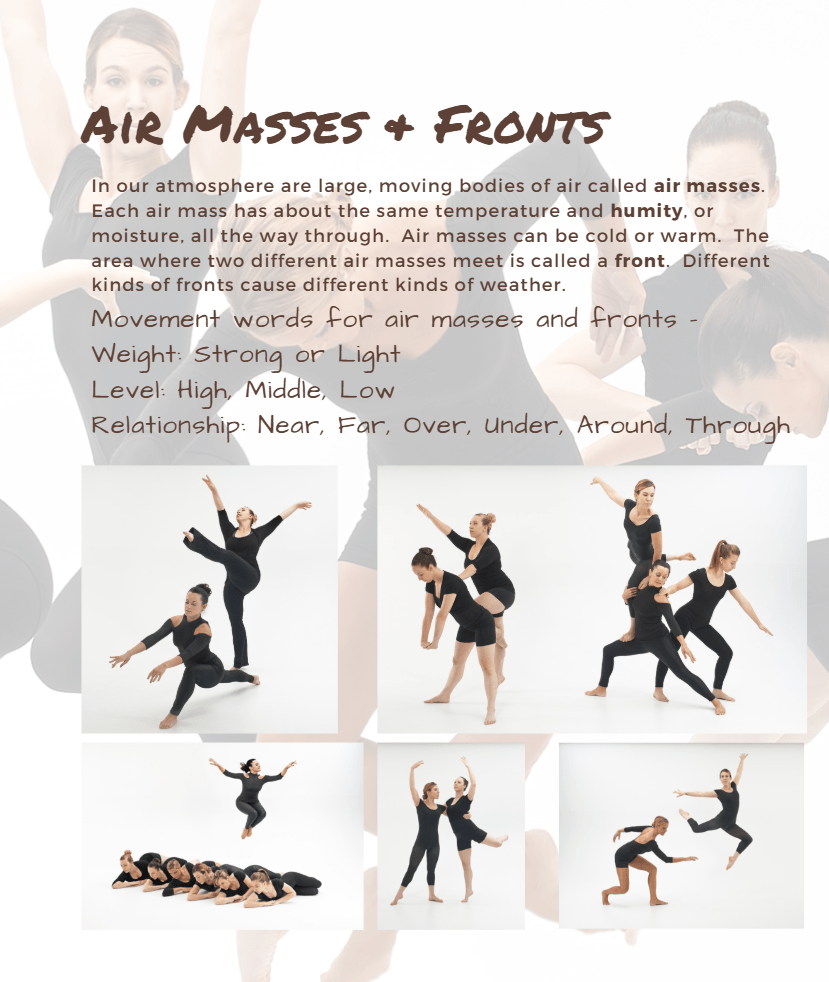
- View a dancer or photos of dancers making shapes.
- Students trace the shapes they see using their finger as a pencil or holding up ribbon to show the visual lines.
- Discuss how shapes can appear in many forms—there is no one “right” way.
Activity Four: Paper Shapes Worksheet

- View the pictures of the dancers and imagine the shapes they make with their body.
- Use a pencil on the page to trace the shapes you see.
- There are many ways to see plane shapes. They are all correct.
Activity Five: Shape Stations
- Set up different stations around the room, each marked with a large plane shape.
- Play music and have students move freely around the room.
- When the music stops, they go to the nearest shape.
- Ask them to trace the shape with their bodies (walking, crawling, etc.) and describe its attributes.
- Rotate several times, discussing angles, sides, and real-world examples.
Adaptations and Modifications:
Learner Needs Addressed:
- Students with visual impairments, motor delays, or sensory sensitivities.
Adapted Materials:
- Use tactile or raised-line shapes.
- Provide shape wands or hand-over-hand tracing support.
Instructional Strategies:
- Use simple, repeated instructions.
- Emphasize consistent shape vocabulary.
Peer Support:
- Assign group roles: tracer, describer, measurer.
- Encourage peer modeling for movement and shape exploration.
Assessment:
- Observe and document how students move to represent shapes.
- Listen for correct use of shape vocabulary.
- Use exit tickets or journals to draw or write about a favorite shape and how they moved like it.
In this lesson, students discover that geometry is not limited to paper—it lives in the way we move, observe, and interact with the world around us. By exploring plane shapes through full-body movement, learners develop a deeper understanding of mathematical concepts while building spatial awareness, creativity, and confidence. Whether tracing a triangle with their toes or identifying shapes in a partner’s pose, students experience math as a dynamic and expressive subject. This kinesthetic approach supports diverse learning styles and fosters joyful, meaningful connections between movement, math, and self-expression.

Leave a comment